|
Contents
Walking Tour
The Cathedral Mosque
Museums
Local Bazaars
Shopping
Iyshan qala
Yurtmaking at Shımbay
Moynaq
Qazaqdarya
Birdwatching and Wildlife
Badai Tugai Nature Reserve
Ustyurt and the Tchink
Aral Sea Expedition
Google Earth Coordinates
Walking Tour
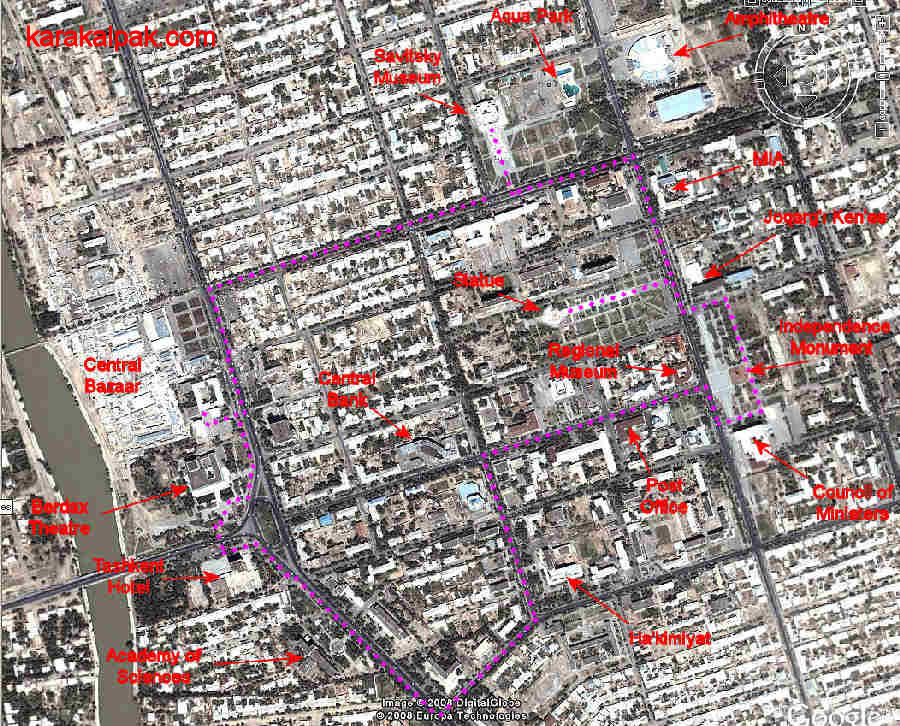
It is possible to see the main sights of No'kis on foot in an hour or so, maybe two if you include a tour of the Central Bazaar. The following
itinerary covers most of the major sights in the downtown area. It includes an optional half-way stop for lunch at a civilized restaurant with
clean toilets in the event that you need a break along the way. Those wishing to follow our tour might want to download a higher resolution copy
of the following map:
Walking tour of downtown No'kis. Download a better copy.
Satellite image courtesy of Google Earth.
Alternatively you might prefer to use our own map of Downtown No'kis.
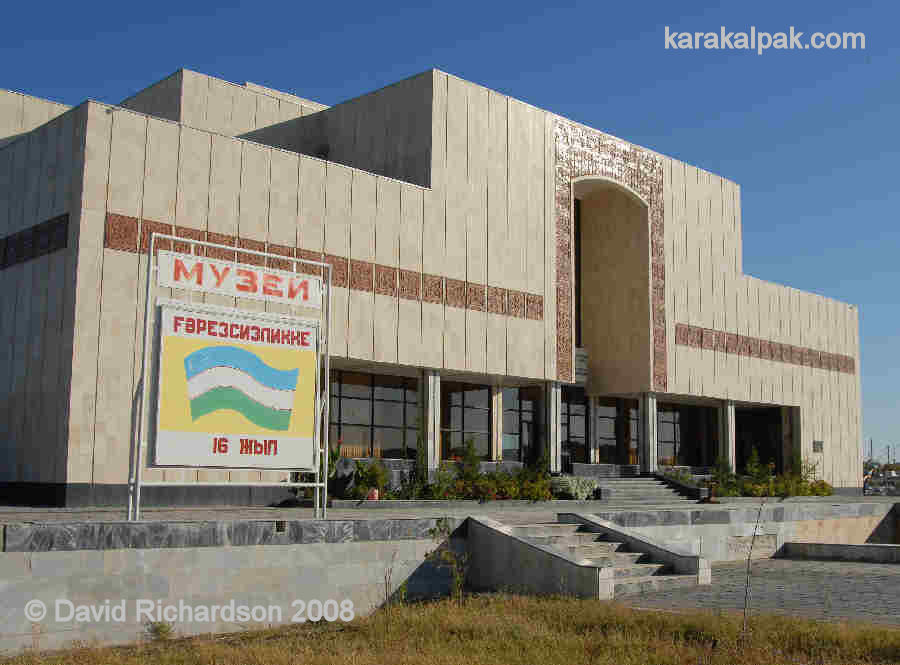
Since almost everybody visits the Savitsky Museum our tour begins from the museum entrance.
The entrance to the Savitsky Museum.
Walk straight ahead towards Rashidov Street. The Karakalpak name for street is ko'shesi, sometimes written as ulitsa in Russian,
abbreviated to ул, or alternatively as prospekt. The open area to the left of the museum is Jaslar Park. It contains
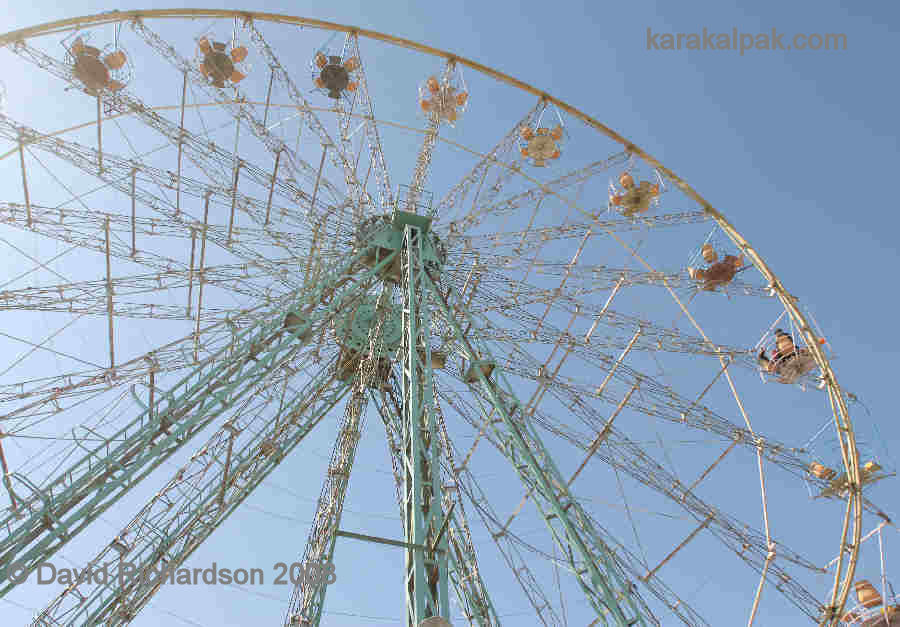
a small Amusement Ground with a Ferris wheel, from the top of which you get good views of the city. The Aqua Park is right next door.
Ferris wheel in the Amusement Park.
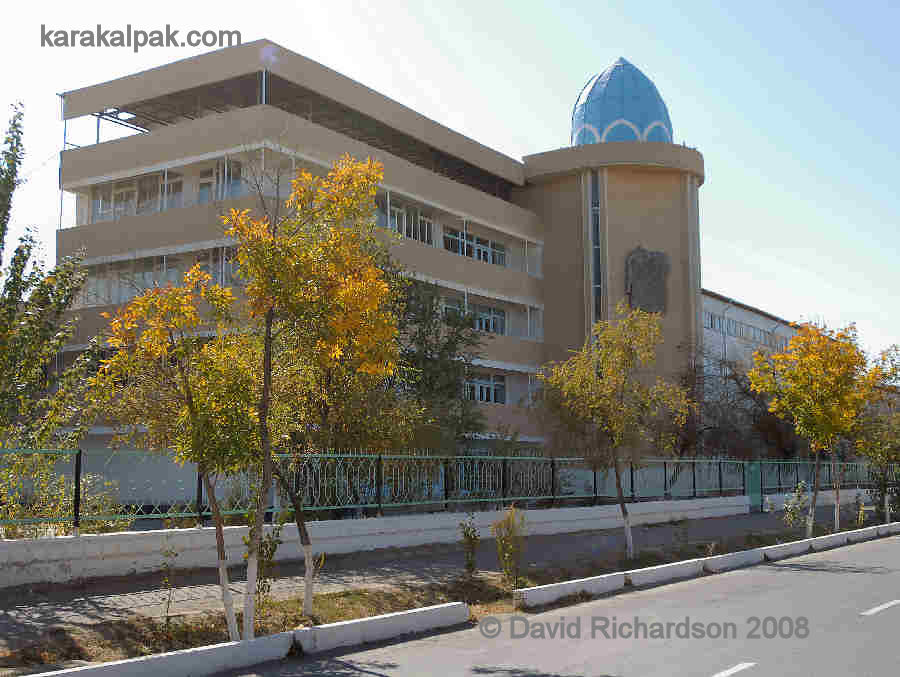
Vladimir Sergeyev Gymnasium.
The building facing you on the other side of the street with a blue cupola is School Number 1, the Vladimir Sergeyev Gymnasium, one of the better
secondary schools in the city. Next door is the Children's Theatre. The building on the corner of Rashidov and Doslıq Guzari (115 Doslıq Guzari)
used to be part of the Old Savitsky Museum. It now houses the museum reserve collection and library, both of which are currently closed.
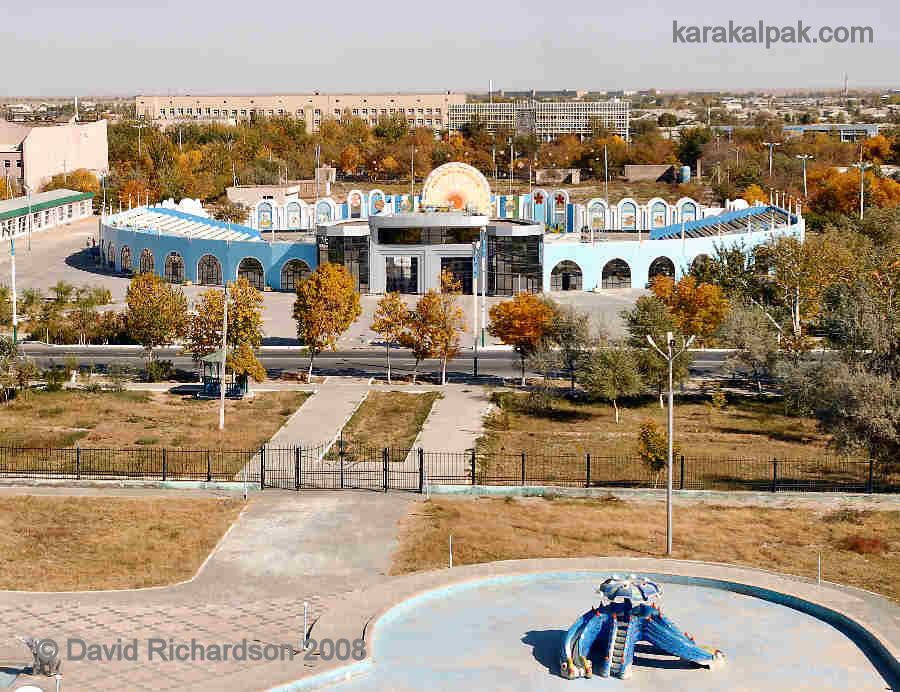
On the opposite corner of the crossroads is a new sports complex and next to that is the Amphitheatre, a circular low-rise building with blue walls
used for open-air dance and other performances (for example, during Nawrız).
Aqua Park and the Amphitheatre.
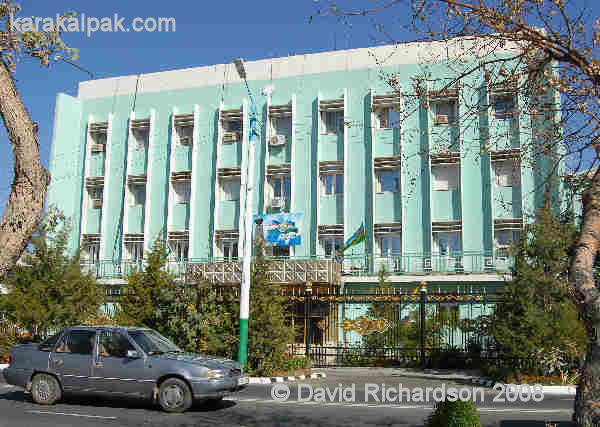
Turn right along Doslıq Guzari, which means "Friendship Way". It is sometimes called President's Way or Presidencia. The all-powerful Ministry
of Internal Affairs is in the turquoise building behind the railings on your left. The No'kis office of IFAS, the International Fund for Saving
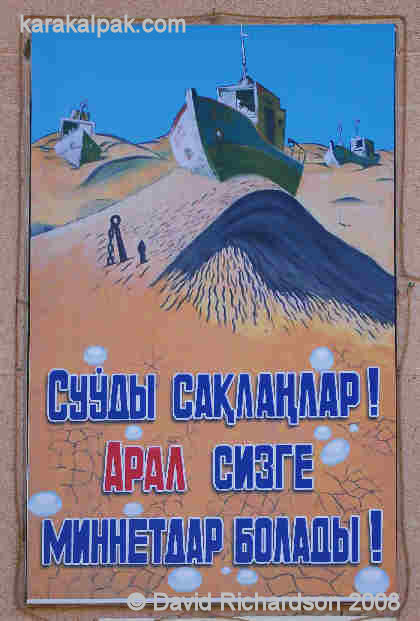
the Aral Sea is on the other side of the road on the corner of G'a'rezsizlik (Independence Street). Formed by the five Central Asian states in 1997,
it has proved to be fairly ineffectual at tackling the Aral Sea crisis, as have most other international initiatives. Local people say that if every
advisor who came to the region brought along a bucket of water, the Aral Sea would be full. It doesn't bode well for solving the threat of global
warming.
The MIA or Ministry of Internal Affairs.
Sign outside the International Fund for Saving the Aral Sea.
It implores readers to "Save Water!"
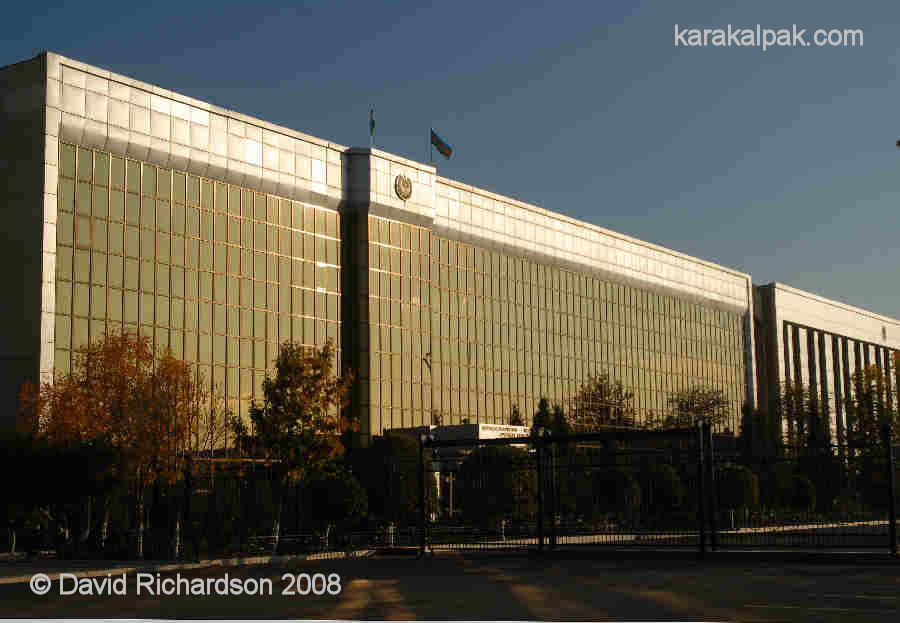
After crossing Pushkin there are two large glass-fronted office blocks on your left. The one closest to Guzari houses the Karakalpakstan
Council of Ministers. The parliamentary chamber is the low-rise building at the back. Unless you are very lucky you will not see very much
activity here. Amazingly the parliament only sits four times a year. However local police and security officials are quite sensitive around this
area, so be discreet with your photography. The security fence around the entrance has only recently been erected. The second building beyond the
Council of Ministers is the National Bank of Uzbekistan.
The Council of Ministers building with the National Bank of Uzbekistan beyond.
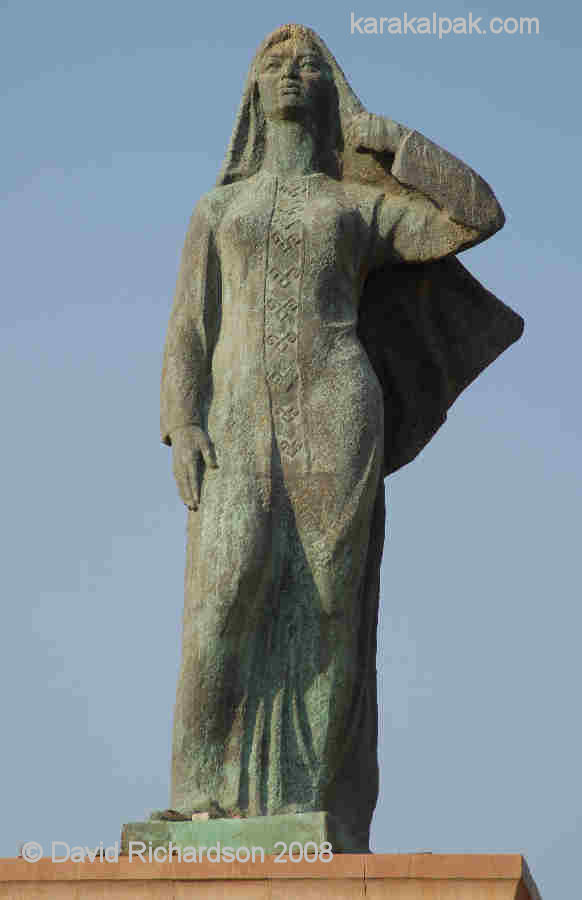
On the opposite side of Doslıq Guzari is a small park containing a fountain, no longer operative, and a fine statue, known as
the Friendship Statue, dedicated to the women of Karakalpakstan. It currently depicts a young woman, standing proud, her head covered
with a kerchief and her ko'ylek embroidered with Karakalpak motifs. However originally there were two young women - one Karakalpak and
one Russian - the Russian one being removed following independence. If you look closely you can still see the mark of her hand on the back of the
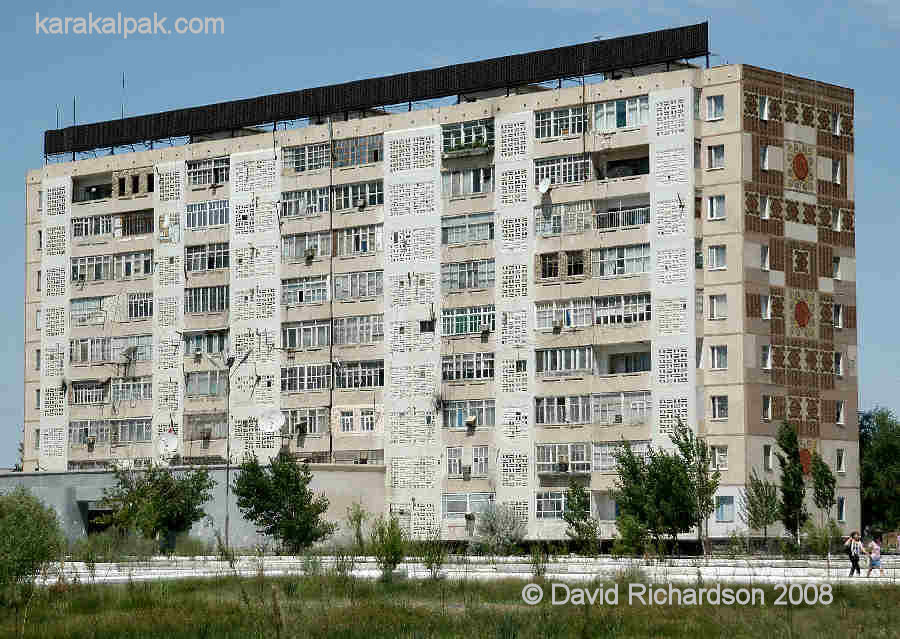
Karakalpak woman's shoulder. The park is bordered by several tall apartment blocks covered with satellite dishes and boldly ornamented with
roundels, crosses, and ram's horns. As you walk around the city you will see many traditional Karakalpak motifs on buildings, fences, and even
market stalls.
The Friendship Statue of a Karakalpak woman.
A relatively good quality apartment block by No'kis standards.
The motifs depicted in the decorative panel are not traditional Karakalpak ones.
Independence Square is the large public space, containing fountains and gardens, in front of the brand new Joqarg'ı Ken'es
building with the flags of Uzbekistan and Karakalpakstan flying from the roof. The Joqarg'ı Ken'es is the legislative assembly of the
Autonomous Republic of Karakalpakstan. This square was the setting for the big Communist processions organized on May Day, with a huge portrait of Karl
Marx hung from one of the buildings and the Party faithful lined up to watch the parade – see Festivals.
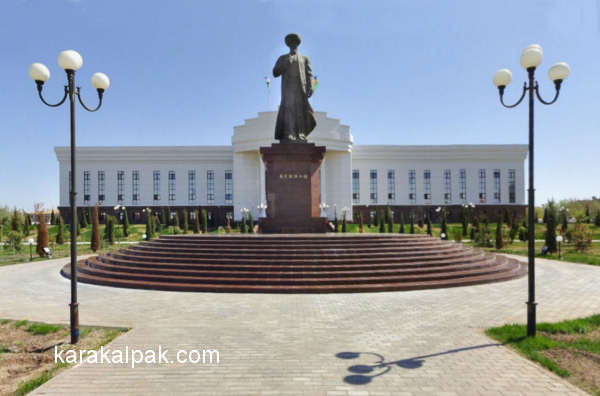
In the centre of the square is a red marble plinth, which today supports a statue of Berdaq the Karakalpak national poet. This used to be the
plinth of the statue of Vladimir Ilyich Lenin, which rapidly disappeared after independence to be replaced with a large rectangular box bearing the
flag of Karakalpakstan on each of its four sides. In 2003 this box was replaced by an obelisk, which in turn was recently replaced by the statue
of Berdaq. The collapse of Communism provided a challenge to city governments throughout the USSR. The regional governors or ha'kimiyats of
Karakalpakstan came up with various creative uses for their red marble plinths, as you will see if you visit the centres of Biruniy, Bostan, or To'rtku'l.
|
The Berdaq statue with the new Joqarg'ı Ken'es building behind.
Turn right into Karakalpakstan ko'shesi, which is directly opposite the Berdaq statue. The Regional Studies Museum used to stand on this site but
was demolished in 2010 and replaced by a bank. They plan to begin construction of a new museum building in 2012 somewhere in the city centre.
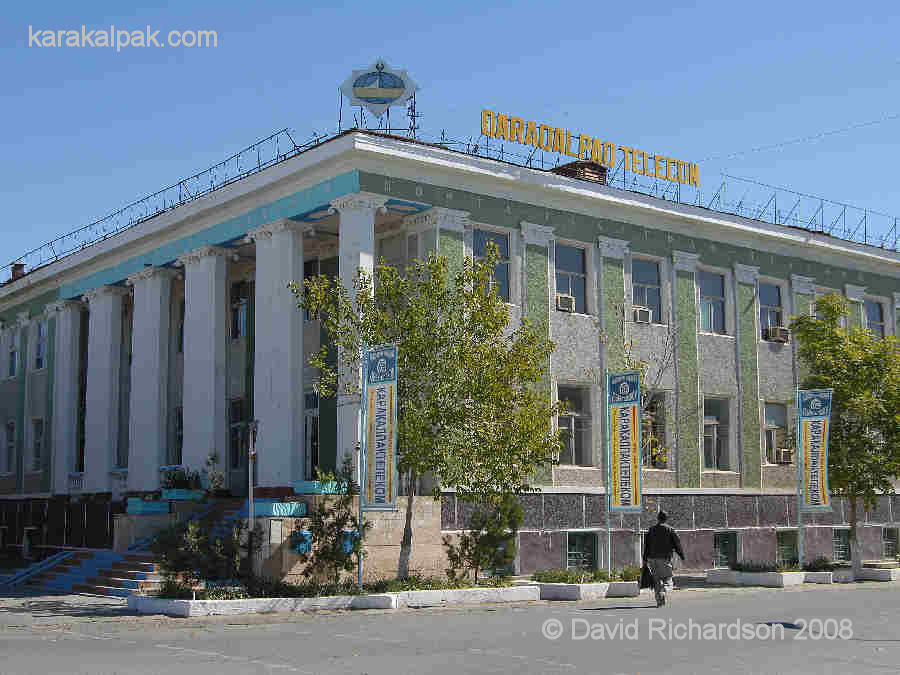
Further down, the Post and Telephone Office is on the corner on the left and the No'kis Hotel is on the right. The
modern building in front of the hotel with the mobile telephone office holds wedding parties. When you reach the intersection at Tatibayev there is
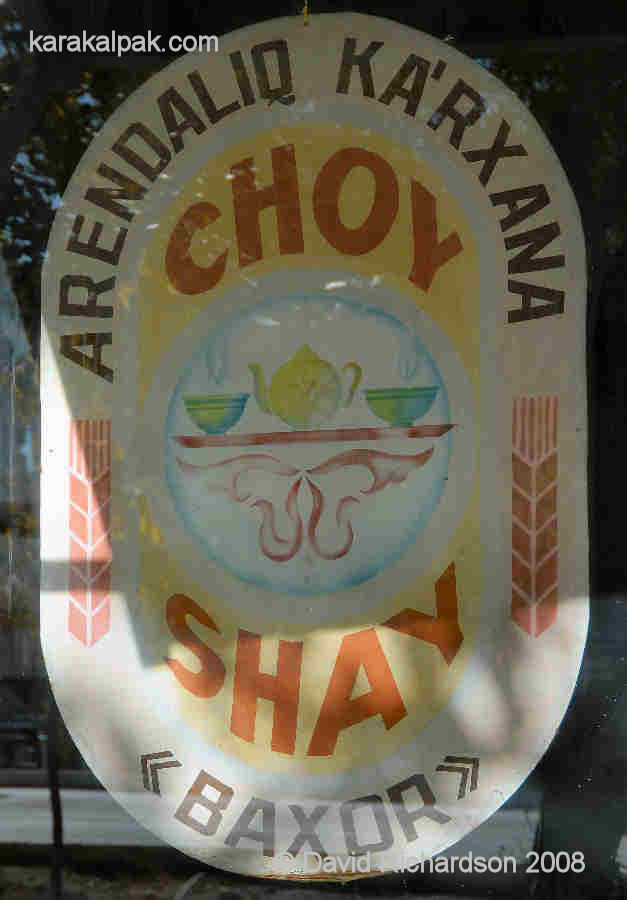
a restaurant on the corner called Aral Asxanasi (meaning the Aral cook-house or dining room) with attractively painted windows. The large
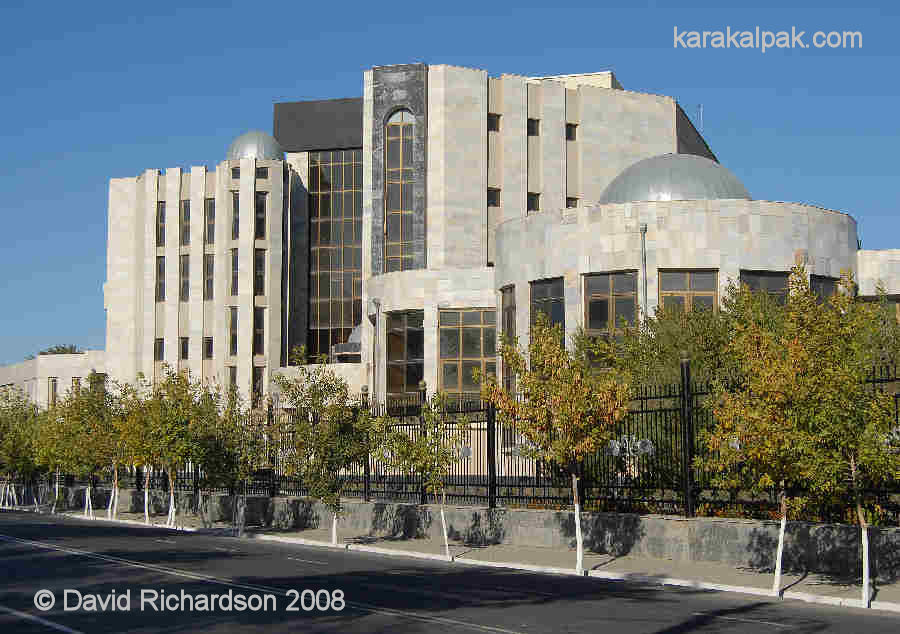
grey modern building clad in Karakalpak marble and surrounded by high metal railings ahead of you on the right is the Karakalpak Central Bank.
The Post, Telegraph, and Telephone Office.
Window sign at the Aral Asxanasi.
The No'kis Central Bank.
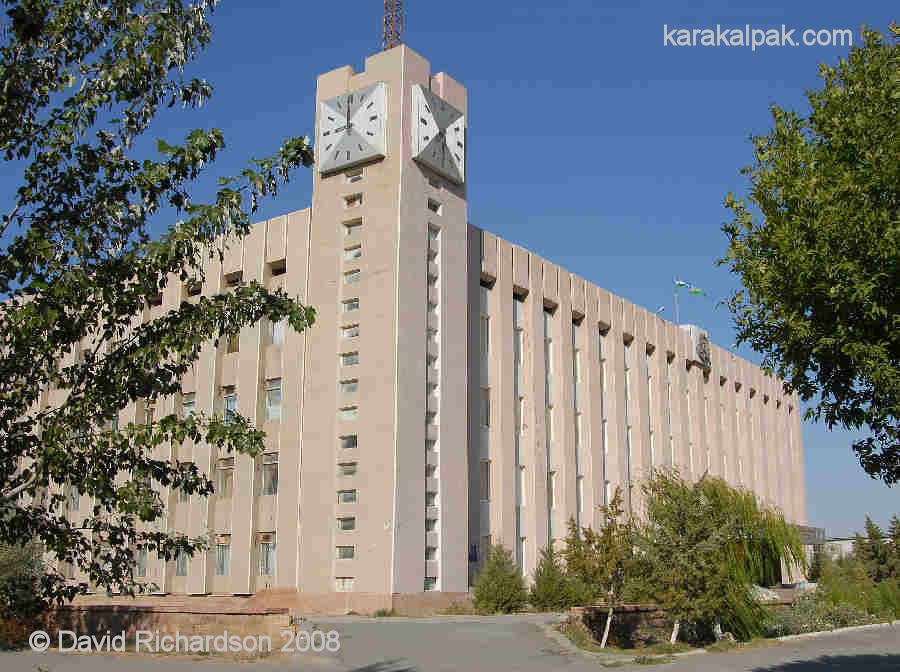
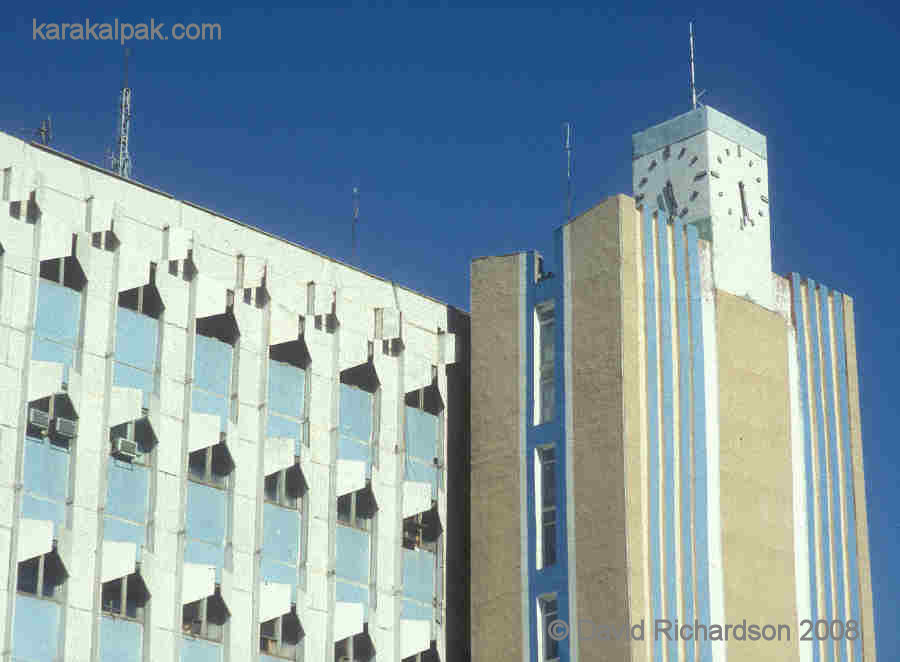
Turn left down Tatibayev until you reach Amur Timur. The large building with the square clock-tower on the left is the No'kis City Hall or
Ha'kimiyat. Go right up Amur Timur until you reach the main To'rtkul ko'shesi highway and then turn right. The white
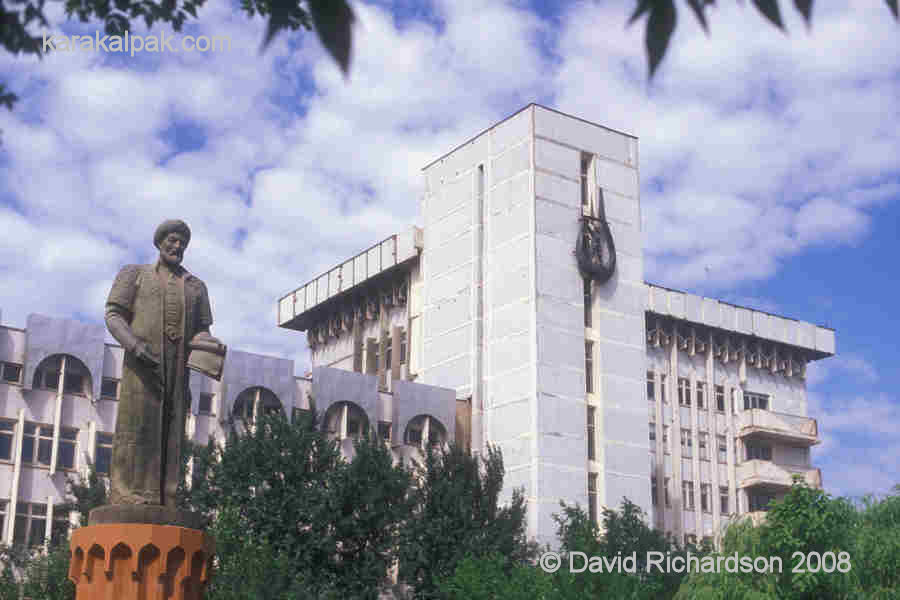
building across the road with the tall blue cupola is the Karakalpak Branch of the Uzbek Academy of Sciences. The current President of the
Academy is Dr Nagmet Aimbetov, a Karakalpak economist. In front of the Academy is a statue of Ulugh Beg the grandson of Timur who established a famous
astronomical observatory in Samarkand. His statue is a popular place with wedding parties for taking photographs.
No'kis city Ha'kimiyat.
Karakalpak Branch of the Uzbek Academy of Sciences with the statue of Ulugh Beg.
Those wishing to break for lunch at this point may wish to try the air-conditioned Merlion, facing the Academy of Sciences on To'rtku'l, one of the
best restaurants in the city.
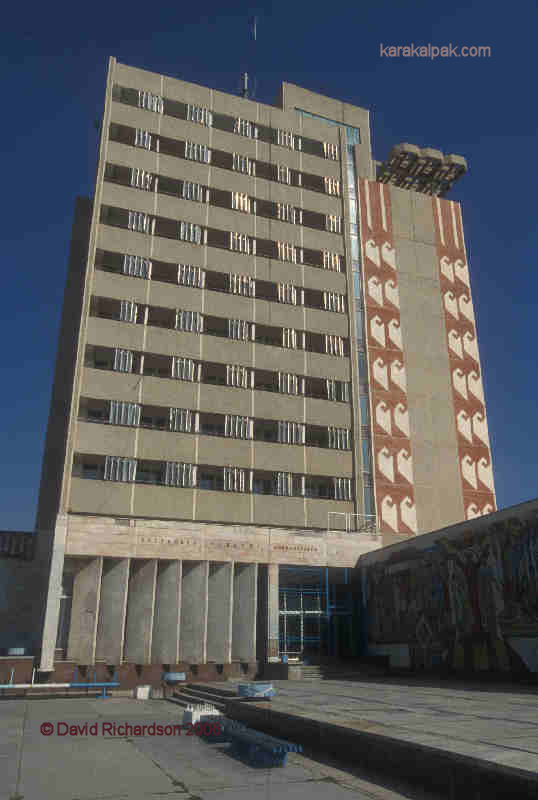
The Tashkent Hotel with Soviet-style wall mosaic.
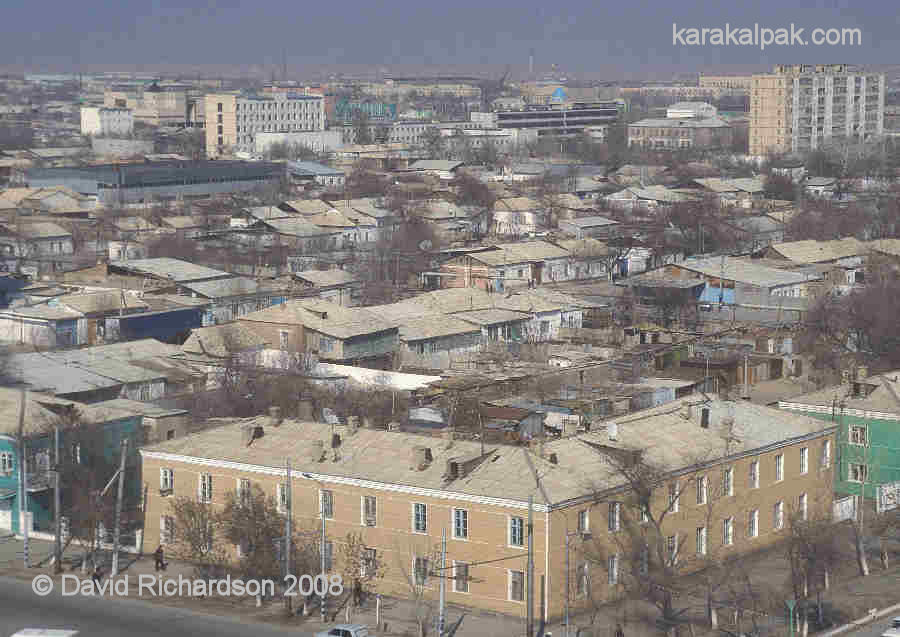
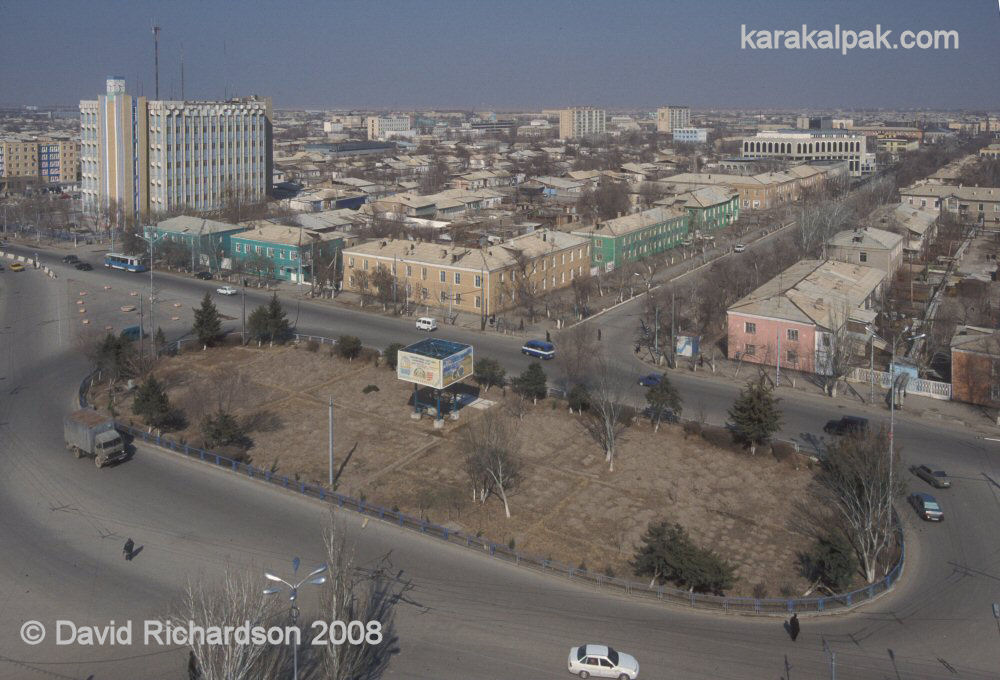
View across No'kis, looking towards the starting point of your walk.
The roundabout linking To'rtku'l, Ernazar Alako'z and Karakalpakstan ko'shesis.
Turn right along To'rtku'l towards the big traffic island. The tall block on your left is the infamous Tashkent Hotel, once the pride of local
Communist officials. It has a large Soviet-style wall mosaic along one side. For the best view in the city, tip the woman on the desk with a 500
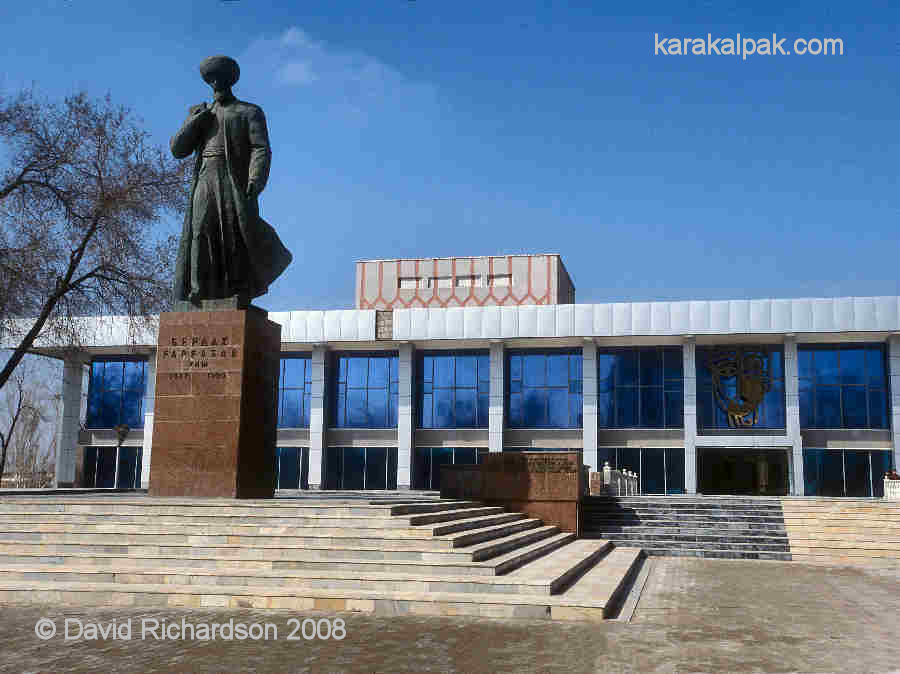
so'm note and ask to go up onto the roof. Across the road on the same side of the island is the Karakalpak State Musical Theatre named after
Berdaq or the Berdaq Theatre for short. Berdaq (1827-1900) was a famous Karakalpak poet and a teller of epic stories who, for a while, was a
musician playing his duwtar at wedding parties. The Berdaq Statue stands in front of the theatre entrance. The tall blue rectangular
block dominating the far side of Ernazar Alako'z ko'shesi is the Central Telephone Exchange.
The statue of Berdaq guarding the Musical Theatre that bears his name.
Central Telephone Exchange.
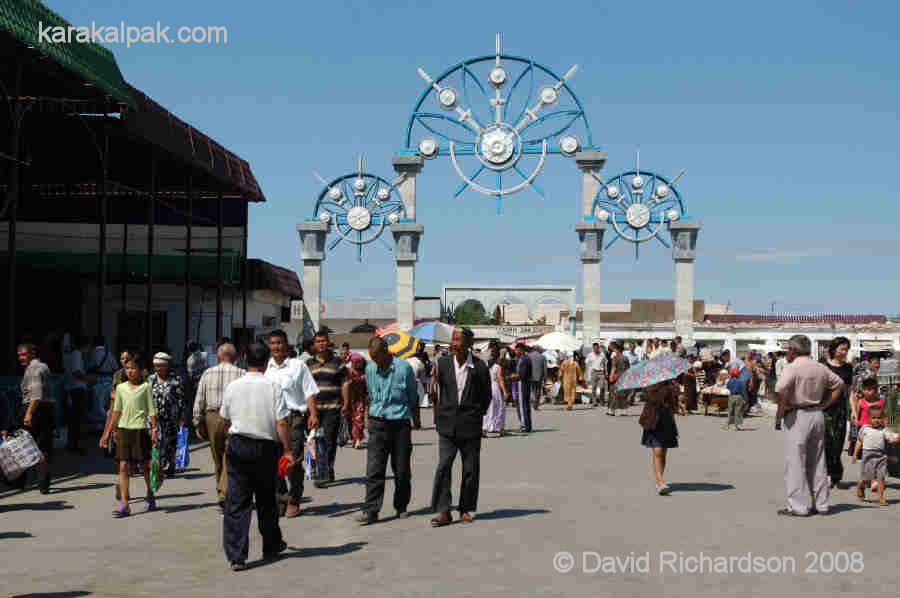
To the east of the theatre and on the left side of Ernazar Alako'z ko'shesi is the sprawling Markaziy Bazar or Central Bazaar,
the commercial heart of the city. It covers almost 9 hectares (22 acres) and contains over 2,000 stalls. In recent years it has been under almost
continuous modernization. There are several entrances, some leading into the covered section. You can buy everything here that you would find in a
Western supermarket and more. On a Sunday the bank along the Qızketken Canal turns into a flea market, with people selling old clothes, books,
and various items of household equipment. The Amu Darya lies 4½ kilometres to the west of the Qızketken Canal.
Entrance to the Central Bazaar.
Inside the Central Bazaar on a quiet day.
The street in front of the bazaar, formerly known as Oktyabrskaya, has been renamed after an important Karakalpak hero who stood up against the Uzbeks
during the 19th century in an attempt to create an independent Karakalpak nation. Ernazar Biy (nicknamed Alako'z) was the leader of
the important Qon'ırat tribal grouping of Karakalpaks. During the 19th century the Karakalpaks were heavily oppressed by the Khan of Khiva,
forced to pay crippling taxes. In response some of the Qon'ırats had rebelled in 1827, killing the Khan's tax collectors. Things came to a
head in 1855 when Ernazar, having united some of the disparate Karakalpak tribes, established an independent Karakalpak Khanate in the Amu Darya delta.
The Khivans sought Turkmen support to end the insurrection and defeated Ernazar and his supporters at nearby Xojeli. After the battle some of the
Karakalpak leaders treacherously switched their allegiance to the Khivan Khan, forcing Ernazar to retreat to the coast of the Aral Sea with 700
Karakalpak families. There they built a fort at the mouth of the Amu Darya, holding out against the besieging Uzbeks for three months. They were
finally overwhelmed in June 1856.
To return to the Savitsky Museum, cross Ernazar Alako'z ko'shesi through the busy underpass and turn right down Rashidov, named after
the popular Uzbek President Sharif Rashidov, who famously embezzled billions of dollars out of Soviet coffers through a long-running 1970s cotton
swindle. Karakalpakstan played an important role in the process since Rashidov's only son was married to a daughter of Qallıbek Kamalov, who held the
post of First Secretary of the Karakalpak Communist Party for 21 years, from March 1963 to August 1984. As such Rashidov maintained a firm grip on
Karakalpak affairs. The "Uzbek Affair" as it became known in Moscow, became a prime target for Gorbachev's anti-corruption campaign. Frustrated at
being continually outwitted by Rashidov's mafia-like ruling clan, Gorbachev finally installed the tough Islam Karimov as the First Secretary of the
Central Committee of the Communist Party of Uzbekistan in June 1989.
Keep walking down tree-lined Rashidov until you get back to the Savitsky Museum.
The Cathedral Mosque
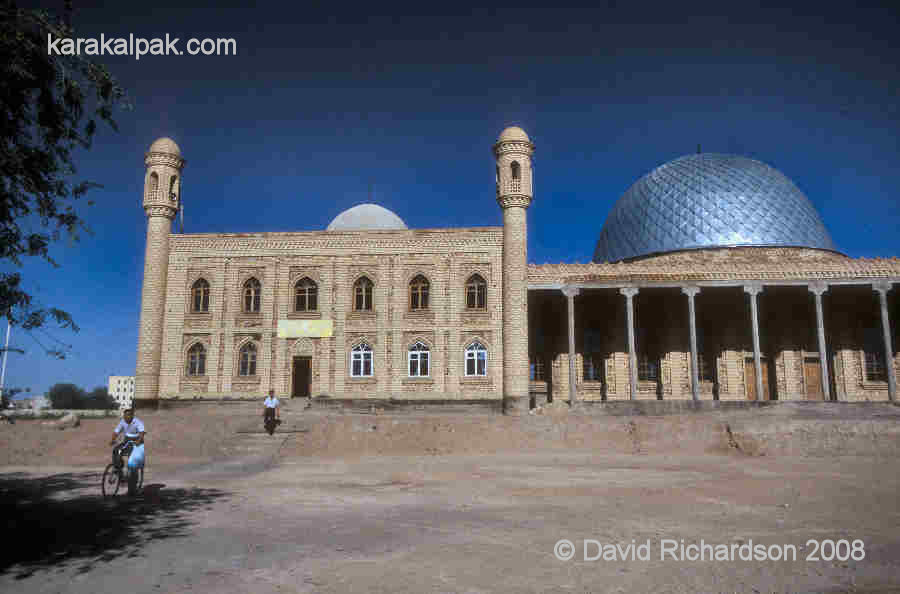
The new No'kis cathedral mosque was built in the 1990s, a decision taken in the heady days following the collapse of Communism when Tashkent saw
advantages in supporting the revival of traditional beliefs . Today the government are not so keen to promote Islam, having witnessed the civil war
in Tajikistan and the rise of the Taliban in Afghanistan.
|
No'kis Cathedral Mosque beside the Qızketken Canal.
To see the mosque leave the Central Bazaar and go north along Ernazar Alako'z ko'shesi until you reach the next main intersection. Turn
left and cross the bridge over the Qızketken Canal. The mosque is situated on the left on the opposite bank of the canal. The best view of
the mosque is from the eastern side of the canal.
Museums
There are numerous museums in Qaraqalpaqstan, but the one that should not be missed under any circumstances is the Qaraqalpaqstan State Museum of Art
named after Igor Savitsky, in short the Savitsky Museum. A small display from the former Qaraqalpaqstan Regional Studies Museum is also worth viewing
at a school on Turan Street.
The Savitsky Museum
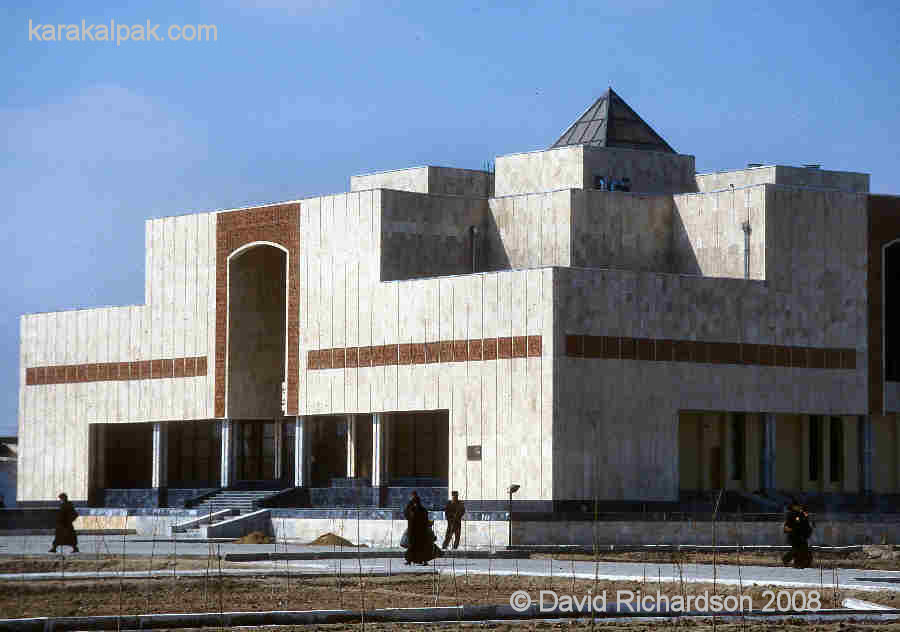
The Savitsky Museum is located in a modern building on the corner of Rashidov and Rzaev streets. Its official address is Rzaev Street but it
actually faces Rashidov. It was reopened by President Karimov on the 12th September 2003, the official 70th birthday of the city of No'kis. Work on
the new building began in the early 1990s but the project soon ran out of money. The concrete shell was a landmark for several years until building
work resumed in 2002.
The Savitsky Museum just after its completion in March 2003.
The director of the museum is Marinika Babanazarova, a helpful and friendly Karakalpak who speaks fluent English and is a tireless promoter of her
museum. She has an enthusiastic staff who speak numerous languages including English, German, and French.
The museum opening hours are:
- Monday to Friday 9.00am to 5.00pm, closed 1.00 to 2.00 for lunch.
- Saturday and Sunday 10.00am to 4.00pm, with no lunchtime closure.
For foreign visitors admission is 15,000 so'm per adult, with reductions for children, students and tour groups. Citizens of Uzbekistan
pay only 3,500 so'm. For an additional fee it is possible to have a guided tour.
Click here for the website of the museum.
Photography is 1,500 so'm per photo up to 5 images, or 15,000 so'm for 6 or more images (as many as you like).
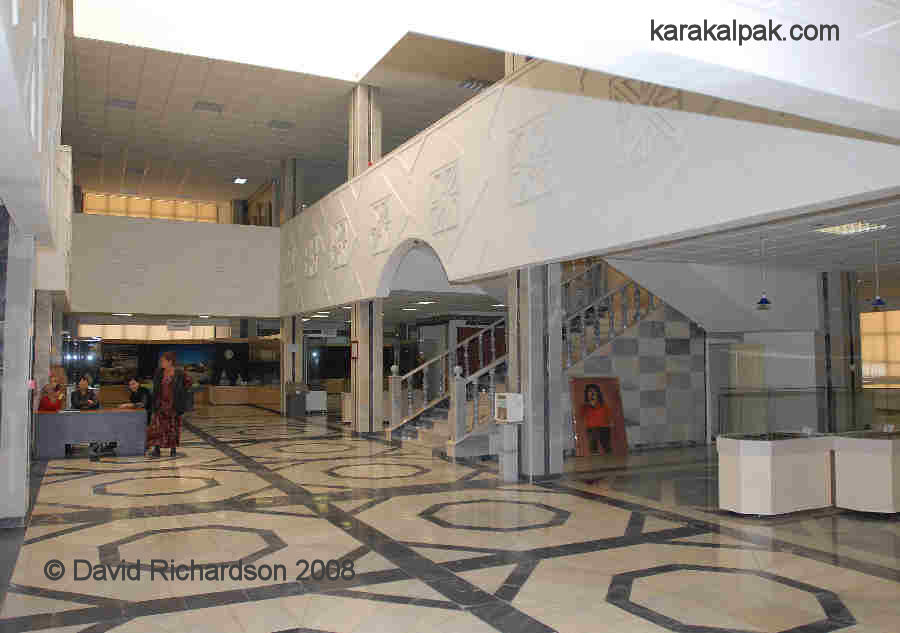
The ground floor entrance.
The ground floor of the museum contains a security desk, ticket office, a cloakroom for depositing baggage, toilets, and a gift and book shop. There
is also a smart café that used to be the best place in town for a light lunch until it temporarily closed in 2007. The first floor houses the
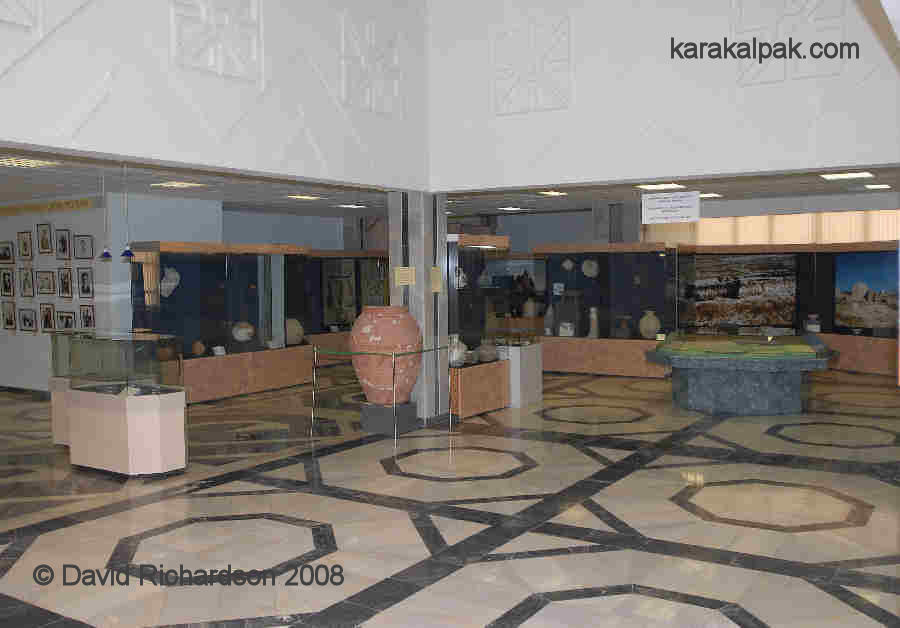
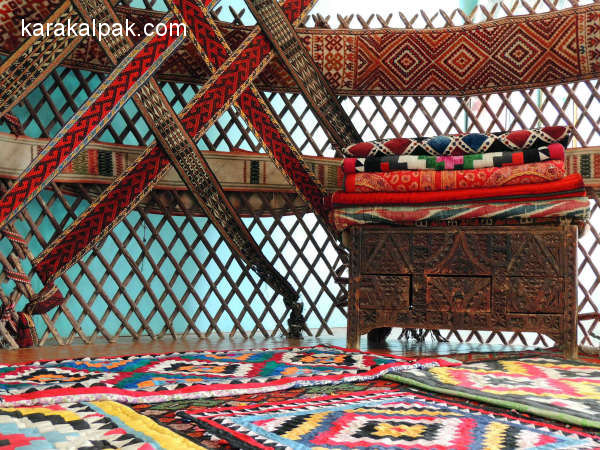
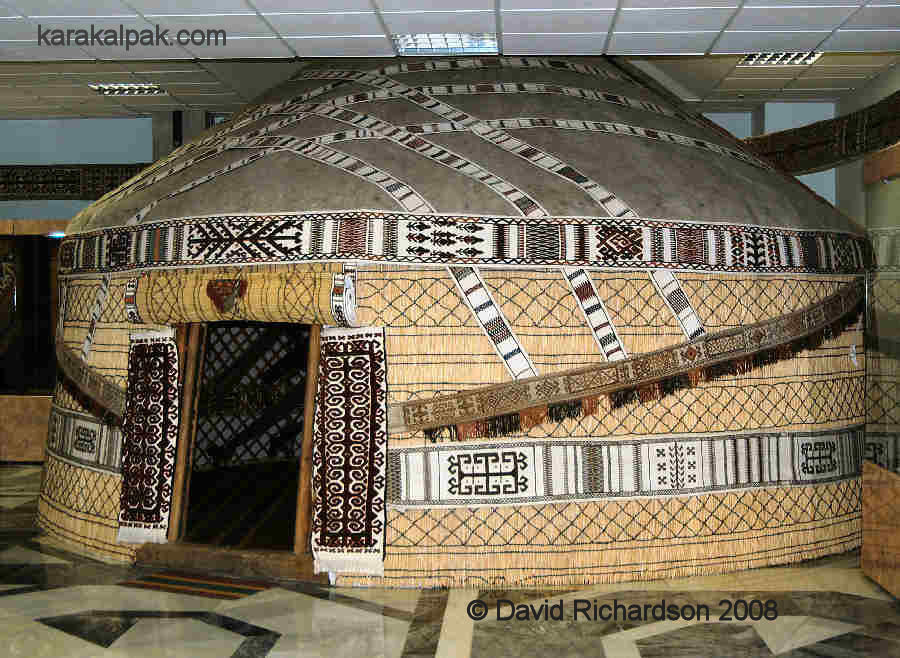
archaeology and ethnographic displays, including a fully decorated Karakalpak yurt. In the archaeology display there are finds from different cultural
periods of ancient Khorezm, dating from its founding to the so-called Afrigid early medieval period. There are also many artefacts dating from the
time of the Mongol Golden Horde, to which the region of Khorezm belonged. The latter include many items of glazed ceramics.
The archaeology section.
There is also a special exhibition marking the 100th anniversary of the birth of Sergey Pavlovich Tolstov (1907– 1976), the founder of the formidable
Khorezm Archeaological-Ethnographical Expedition. He and his team of young researchers conducted pioneering work on the archaeology and ethnography
of the whole Khorezm region, includingy the Amu Darya delta, from 1938 until the collapse of the Soviet Union some 15 years after his death. The
exhibition includes photographs of the expedition, many additional paintings of archaeological sites by Savitsky, and the frescos recently recovered
from Kazakl'i-yatkan.
Look out for the unusual collection of ossuary – clay vessels used for the storage of the bones of the deceased. Ossuary burial was an Iranian
Zoroastrian custom that once thrived in this region, quite distinct from the kurgan-style of burial used by the later Turks. Hundreds of ossuaries
have been recovered from the necropolis at Mizdahkan, one in the shape of a boat dating from 2nd-3rd century AD, which contained gold jewellery, a
bronze bowl, a mirror, and a spoon. Many ossuary were fashioned with the body of an animal and the head of the deceased – one is in the shape of a
camel. The finest ossuary comes from the unusual Kerder people, a culture formed from the fusion of peoples from Khorezm and the lower Syr Darya as
well as immigrant Turks. They lived in the northern delta from the 7th to the 11th century. The ossuary was found at Toq qala,is made of
alabaster and is painted with a scene of mourning. Dating from the 7th or early 8th century, it shows people wearing Turkic costume, in particular
a long coat with a single lapel.
|
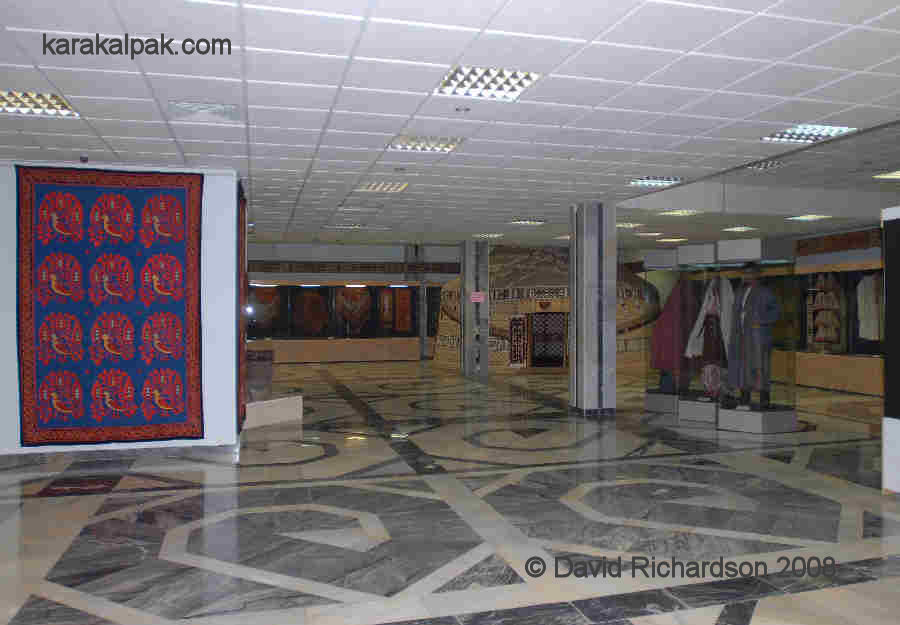
Part of the ethnographic display.
The ethnographic collection contains a mixture of costume, jewellery, and items for the yurt. Don't miss the rare sa'wkele and to'belik
headdresses, which were both restored in Moscow, or the blue embroidered ko'k ko'ylek wedding gowns. There are many magnificent examples of
Karakalpak embroidery, which was made in two styles – geometric cross-stitch embroidery on coarse white cotton or flowing chain-stitch embroidery on
machine-made red felted cloth. The displays, which are unfortunately behind glass, include white and red kiymesheks, and several fabulous
white and red jegdes. The museum has by far the finest display of Karakalpak jewellery, which can be compared alongside similar examples from
the Turkmen, Qazaqs, and Uzbeks. The Karakalpaks were not great carpet weavers – all the large items on display are relatively new. They specialized
instead on making tent bands and small pile-woven rectangles, which were used as the faces of similar shaped storage bags or for decorating the area
above the inside of the yurt door – the so-called esikqas or "eyebrow of the door".
|
The museum's yurt, made in Shımbay.
The gallery of fine art starts on the first floor and occupies the whole of the second floor. Look out for the small display about Igor Savitsky,
including some of his paintings of yurts and ancient mud-brick fortresses. The main collection of paintings principally divides into two: Uzbek art
of the 1920s and 1930s and 20th century works of the Russian avante garde. In addition there are some examples of local contemporary
painting and sculpture. Paintings in the first category range from the powerful works of Nikolay Karakhan and Aleksandr Volkov to the more subtle
images of P. P. Benkov and Yelena Korovai's the Indigo Dyers. Fine examples of Russian avante garde are provided by Aleksandr Shevchenko,
the Moscovite Robert Falk, and the Crimean artist Maksimilian Voloshin with his wonderfully earthy landscape watercolours.
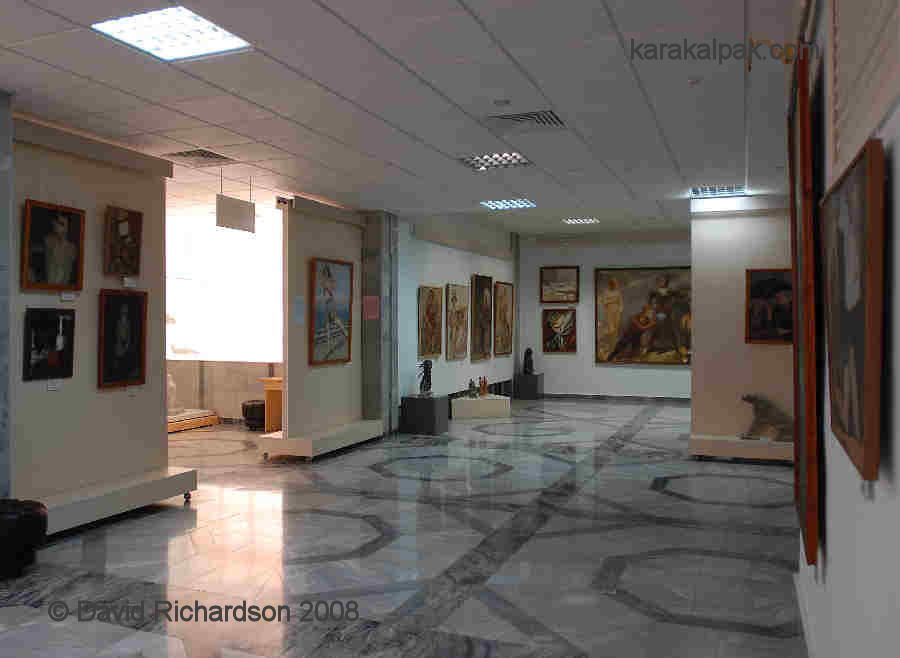
Part of the art gallery.
It is hard for us as Westerners to understand why these enormously varied paintings were so potentially offensive to official Soviet sensibilities.
The Russian avante garde movement began in the mid-19th century and quickly flourished, actually gaining momentum following the 1917 revolution
and the removal of the repressive Tsarist regime. Indeed in the early 1920s the Soviet regime exploited the work of these free-thinking artists for
the purposes of propaganda. In time leading Marxist-Leninist theoreticians began to criticize certain artistic movements such as the impressionists
and the cubists, as decadent and bourgeois, creating a distorted or absurd image of reality beyond the grasp of simple workers and peasants. They
argued that the role of art in Soviet society, where all property was collective, was to further the aims of socialism and the needs of the proletariat
as embodied in the Communist State. Only art that was proletarian, represented everyday life in a realistic manner, and reinforced the objectives of
the Party and State was acceptable. Following Stalin's 1932 decree "On Restructuring Literary and Artistic Organizations", this became the only style
of Soviet art permissible, subsequently termed "Soviet or Socialist Realism". It was enforced through the entire State apparatus of censorship and
repression. Those who refused to comply with this official line were persecuted, denied employment, arrested, imprisoned, and exiled.
Although the atmosphere eased a little after the death of Stalin, Khrushchev maintained broadly the same policy. In 1962 Khrushchev reacted to an
exhibition of abstract art in Moscow by exclaiming: "The people and government have taken a lot of trouble with you, and you pay them back with this
shit!" Twelve years later bulldozers and water cannon were used to destroy an open-air exhibition of modern art in the same city. In assembling
his collection Igor Savitsky was breaking all the rules. It was dangerous work, punishable by detention in a work camp had he been exposed to the
powers that ruled in Moscow. Fortunately for Savitsky his endeavours were never exposed to political criticism and his marvellous collection survived
intact. It stands as a monument to his vision and bravery.
Savitsky's museum provides a timely reminder to all of us about what happens when governments start deciding what we should or should not see, should
or should not think.
Click here to see a video of the museum.
The Regional Studies Museum
The Regional Studies Museum, sometimes called the Karakalpak State Museum for History and Regional Studies, is the oldest museum in Karakalpakstan.
It was initially founded in 1929 as the Scientific Research Institute at To'rtku'l, the former capital of the Karakalpak Autonomous Oblast.
Following a major flood in 1942 during which part of the collection was destroyed the museum was moved to the new capital of No'kis in 1944. In
1965 the museum was relocated into a larger building on the corner of Doslıq Guzari and Karakalpakstan (the official address was
2 Karakalpakstan Street), where it shared space with the art gallery of the Savitsky Museum.
Sadly the museum was closed with just a few days notice in December 2010 and the entire building was demolished to make way for a new development.
Attempts to find a new location for the museum in the city centre have to date come to nothing. However a small part of the former exhibition is
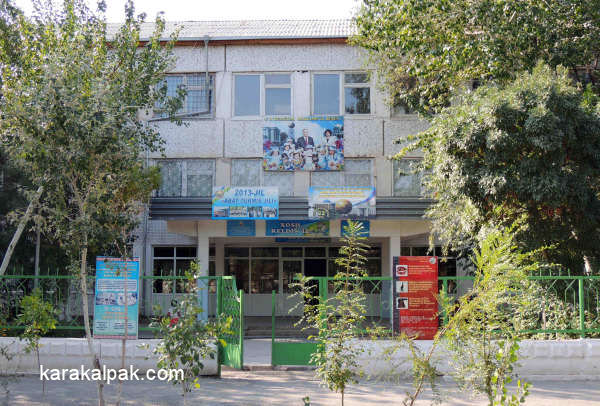
currently on display in an upstairs room at a city-centre school building, Pushkin Gymnasium Number 1, 45 Turan Street.
The Pushkin Gymnasium Number 1 on Turan Street.
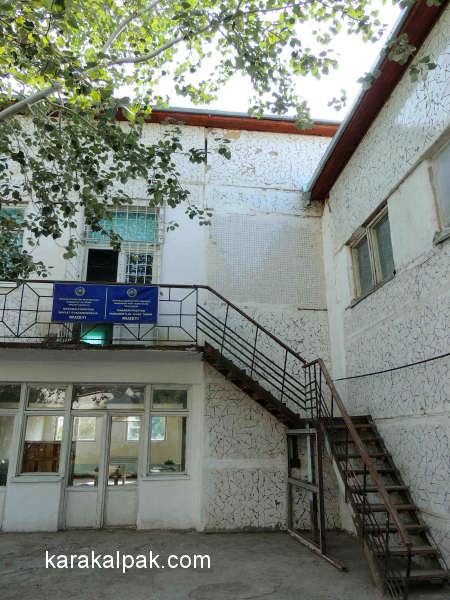
The Rear Entrance to the Exhibition.
The opening times are from 0900 to 1700, Monday to Friday, and 1000 to 1600 on Saturday. Admission is a modest 8,000 so'm, photography
is free, and tours in English are available.
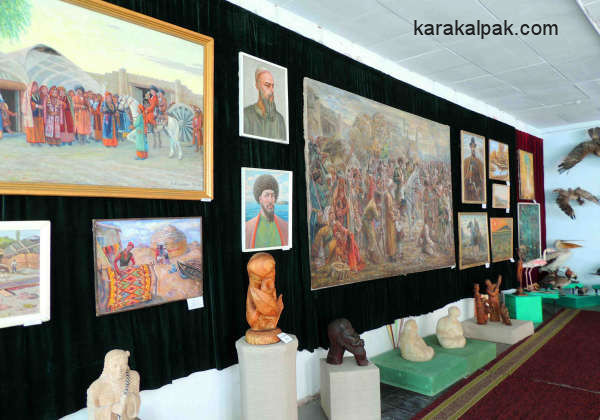
Paintings depicting episodes from Karakalpak history.
The Karakalpak yurt display.
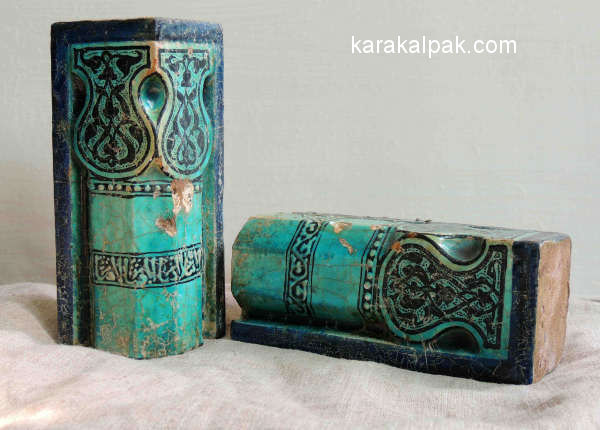
Archaeological exhibit of ancient Khorezmian tilework.
Because of the limited space available the exhibits on display are restricted to a Karakalpak yurt, a number of historical paintings, some
archaeological artefacts and several displays relating to the natural history of the Aral region. Unfortunately the majority of the museum's
60,000-strong collection remains in storage, including a rare sa'wkele, a magnificent ko'k ko'ylek, and a fabulous embroidered
jegde.
The Berdaq Museum
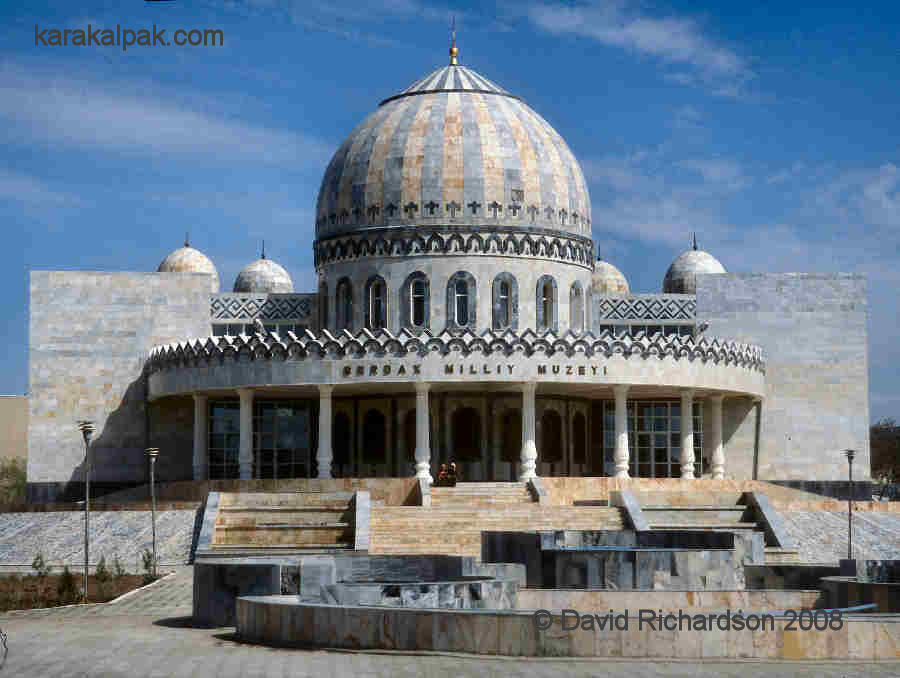
The brand new Berdaq Milliy Muzeyi or National Museum looks like a huge mausoleum, clad in grey and white Karakalpak marble.
The Berdaq National Museum.
It is situated on Doznazarov ko'shesi about half a kilometre south of Independence Square, next to the main campus of the Karakalpak State
University. Built around 2002, it must have been the pet project of a local politician that has now turned into a white elephant. The building has
been devoid of exhibits since its completion and in 2007 the outer gates were chained and padlocked. It makes a nice photograph though.
The House Museum of A'met and Ayımxan Shamuratov
This small private museum is located just at the back of the Savitsky Museum at 29 Sarayev ko'shesi, on the corner with Rzaev ko'shesi
abutting the Jipek Joli Hotel. It opens every day from 9 am to 6 pm. Admission is $2 per person. Telephone: (+998 61) 222 11 00, 222 34 52.
Ayımxan Shamuratova (1917-1993) was a popular Karakalpak singer, dancer, and actress who frequently performed at the Berdaq Theatre in No'kis.
She first went on the stage in the 1930s, when it was dangerous for a woman to perform in the face of threats from Muslim conservatives. She became
famous for her rendition of traditional Karakalpak folk songs and was rewarded with the status of a People's Artist of Karakalpakstan at the young
age of 23. In 1968 she was acknowledged as a People's Artist of the USSR. Her husband A'met Shamuratov (1912-1953) was a Karakalpak writer and
Communist politician. In 1952 he became Chairman of the Karakalpak Writer's Union but died early, leaving his widow with nine children.
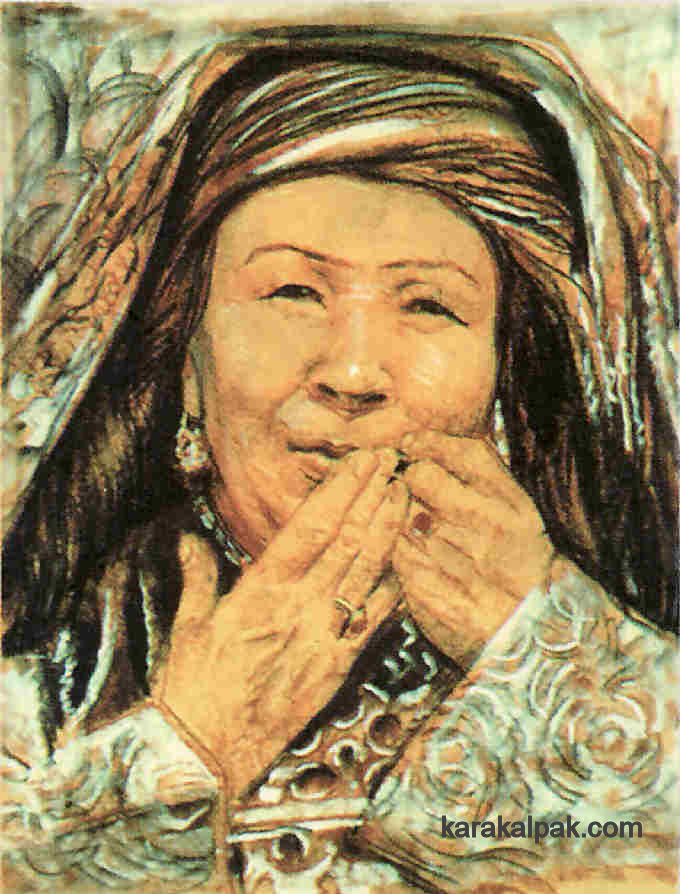
Portrait of Ayımxan Shamuratova.
The museum displays the family's personal belongings such as their clothing, photographs, books, documents, portraits, and theatre posters. It gives
an insight into the life of an urban Karakalpak middle-class family from the 1930s onwards. The family possessions have been enhanced with a
collection of photographs of past Karakalpak dignitaries and items of local handicrafts and items of folk art, including a kiymeshek made by
Ayımxan's mother. There is even a decorated Karakalpak yurt outside of the museum.
The Museum of Battle and Labour Glory
Located on To'rtku'l ko'shesi, this museum is also funded by the Ministry of Culture. We have never visited it.
Regional Museums
There are small regional museums located at Moynaq, Biruniy, Bostan, and To'rtku'l. They contain examples of Karakalpak folk art and photographs
and artefacts related to the history of each town. Their opening hours vary, and sometimes it is necessary to ask the whereabouts of the curator
so that the museum can be opened especially for you. They can be closed for a month or more during the October cotton picking season.
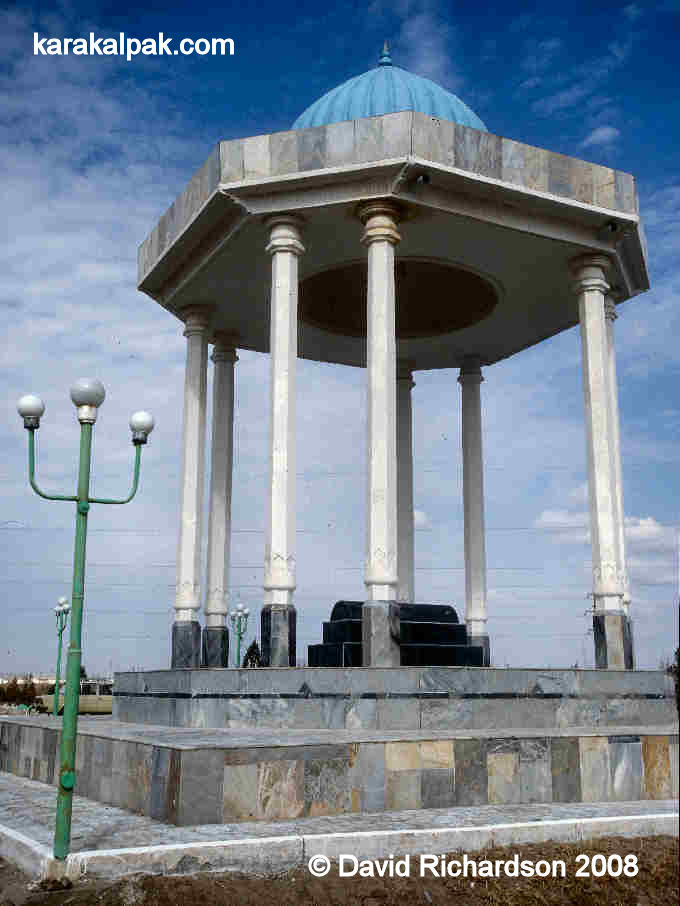
The al-Biruni Monument just outside of Biruniy City.
There have been plans to create a museum dedicated to al-Biruni just outside Biruniy, close to the al-Biruni Monument. To date all that exists is
an empty concrete shell.
Local Bazaars
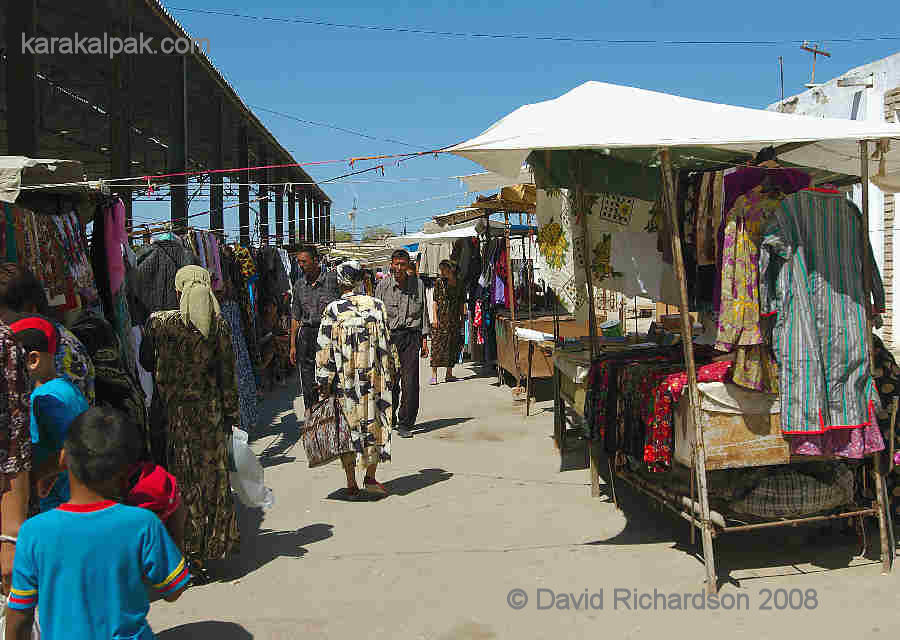
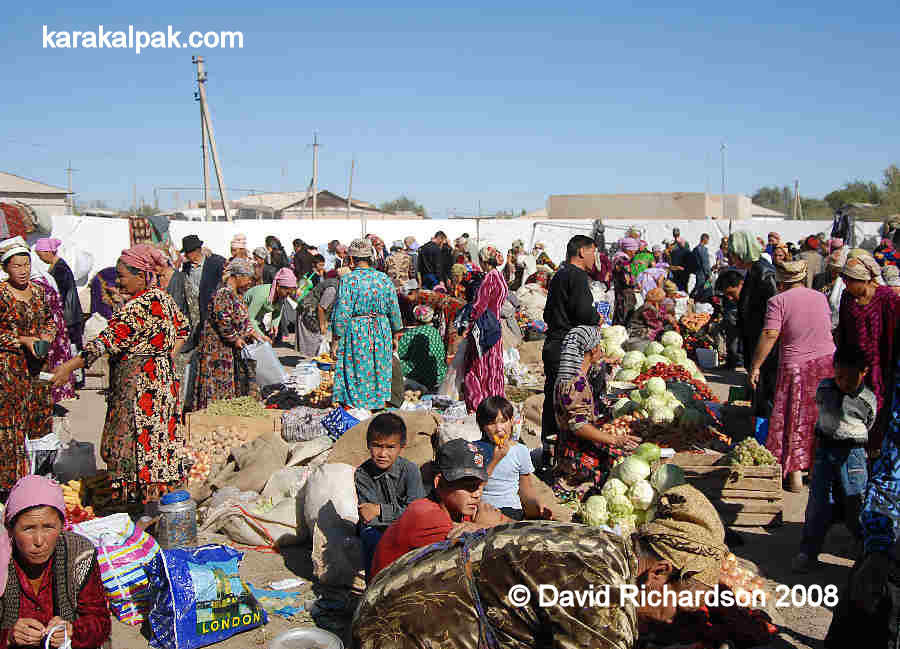
The Central Bazaar or Markaziy Bazar is a great place to get a flavour of local life. Unlike Samarkand or Bukhara there are no supermarkets
or modern shops in No'kis so most people buy their weekly provisions here. If you are staying in Karakalpakstan for a while this is the best place
to get your toiletries, booze, and things for a picnic lunch.
The stretch of road in front of the bazaar tends to be chaotic all day long. The best place to park is at the side of the bazaar, next to the Berdaq
Theatre.
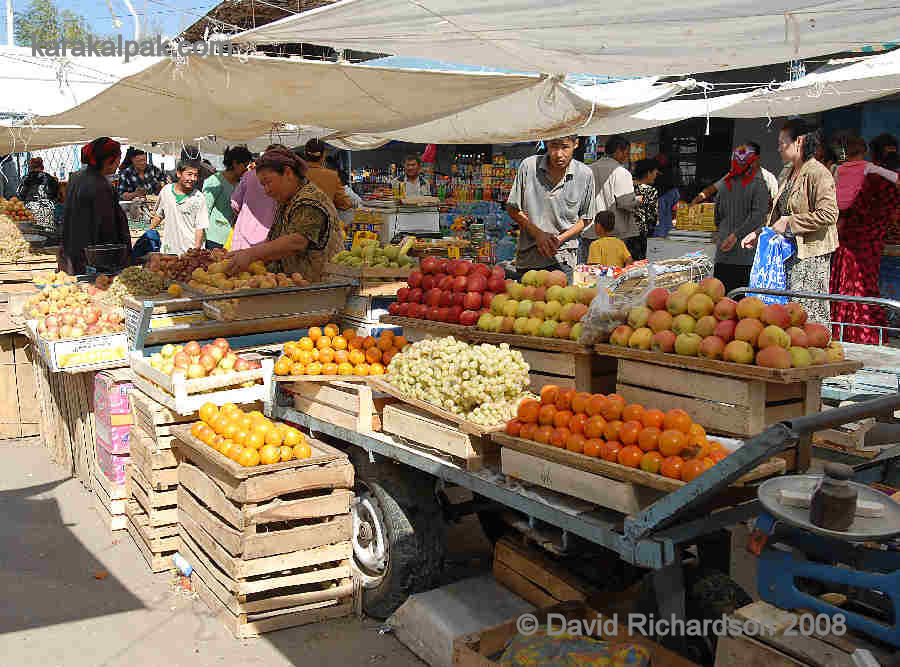
Fresh fruit for sale at the Central Bazaar. Local melons are not to be missed in the autumn.
The proprietors of the market's 2,000 stalls sell fresh bread, meat, pasta, rice, vegetables, fruit, milk, bottled water, soft drinks, beer, and wine.
There are specialists selling hot food, toiletries, CDs, televisions, textiles, clothing, shoes, and even wedding dresses. Dairy products, smoked
sausage, biscuits, and chocolate are available in the covered section at the front of the market. At the very back is a roofed section selling
second-hand furniture and poor quality bric-a-brac. Close by is a row of stalls selling Russian scarves and second-hand books.
See Shopping below.
There is a second city bazaar called Aydinjol, located on the north outskirts of the city not far from the airport. It was badly damaged by a fire in
late 2007 and is currently being rebuilt.
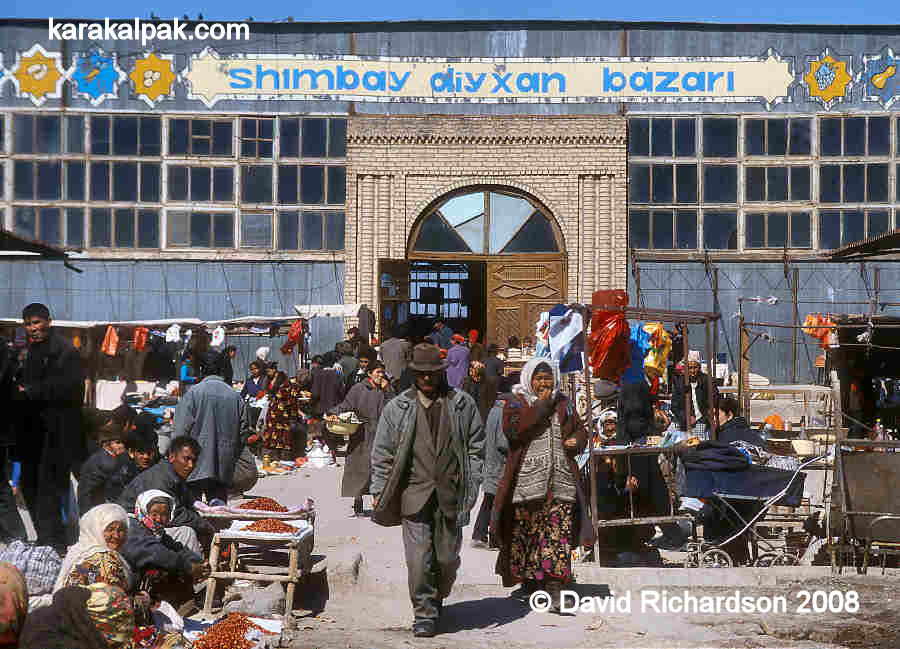
The covered Diyxan Bazarı or Farmers' Market at Shımbay Bazaar.
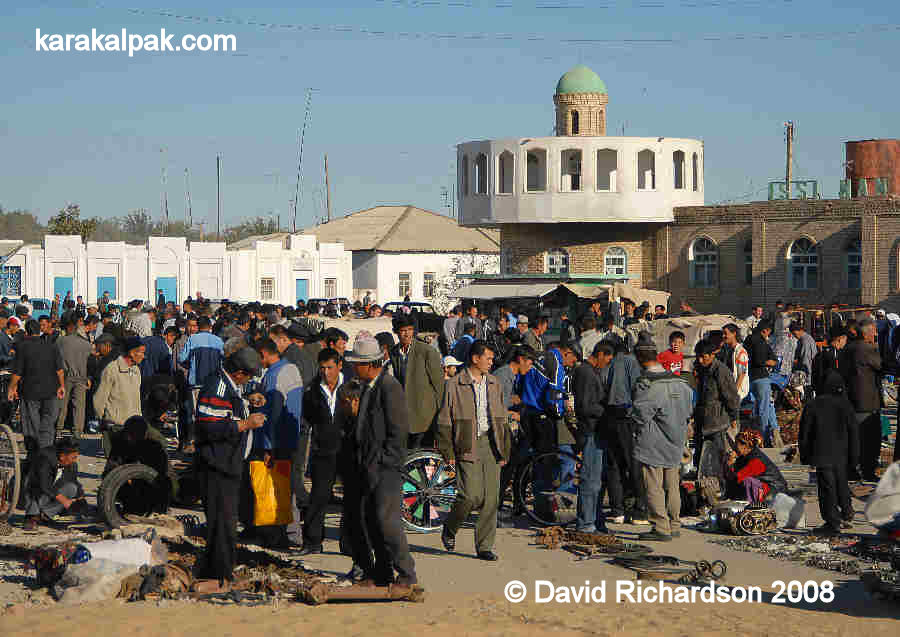
Selling mechanical parts at the big Shımbay Sunday Bazaar.
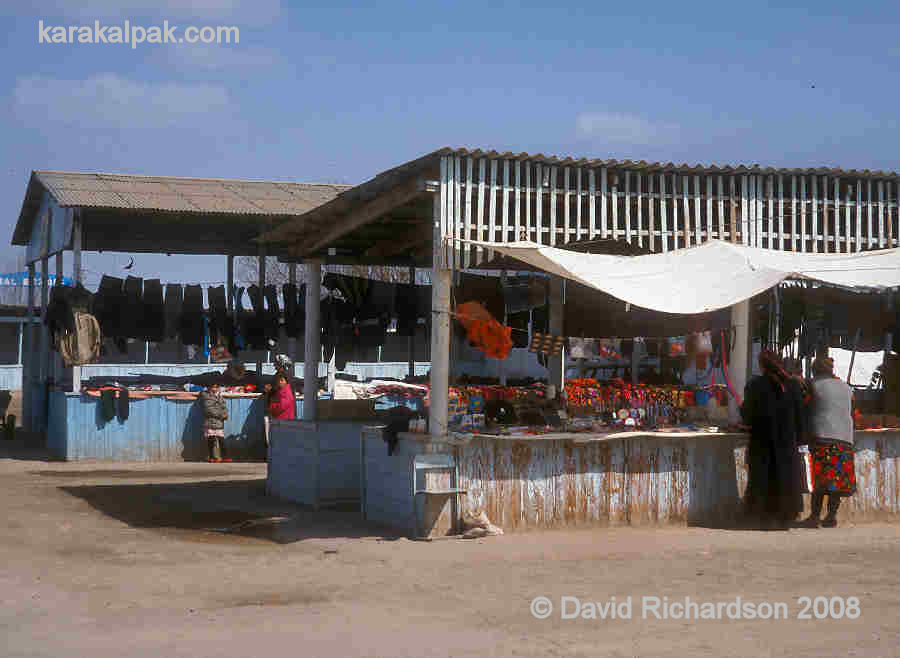
There are quite large regional bazaars at Xojeli, Shımbay, Shomanay, and Qon'ırat. Xojeli bazaar is on the left side of the main road
from No'kis to Qon'ırat to the north of the town centre. To find the bazaar in Shımbay, drive 55km north from No'kis until you reach the
point where the road divides in front of the enormous covered statue of a woman. Fork left and after half a kilometre you will find the bazaar on the
right, just before the bridge over the canal.
A quiet day at the small Shomanay Bazaar.
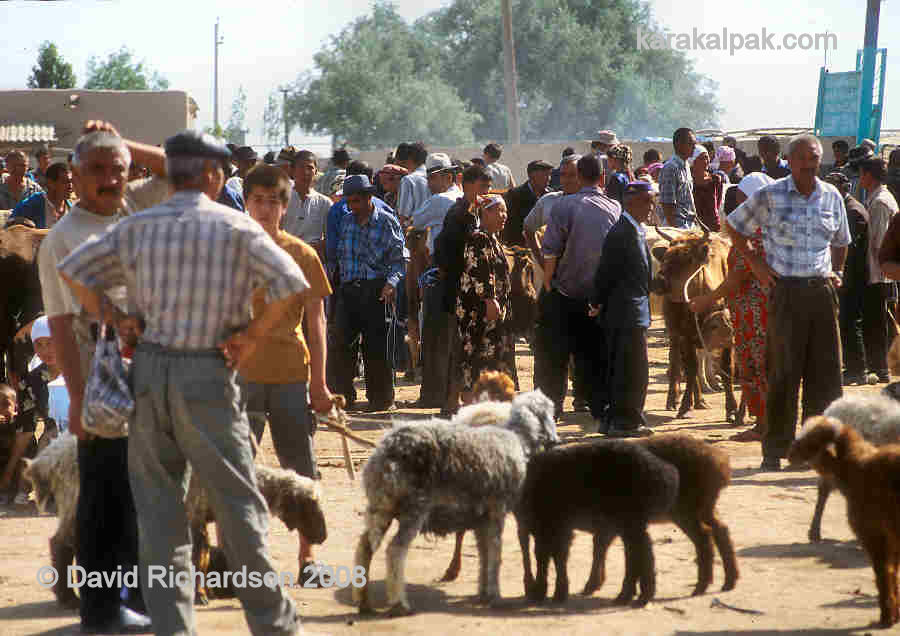
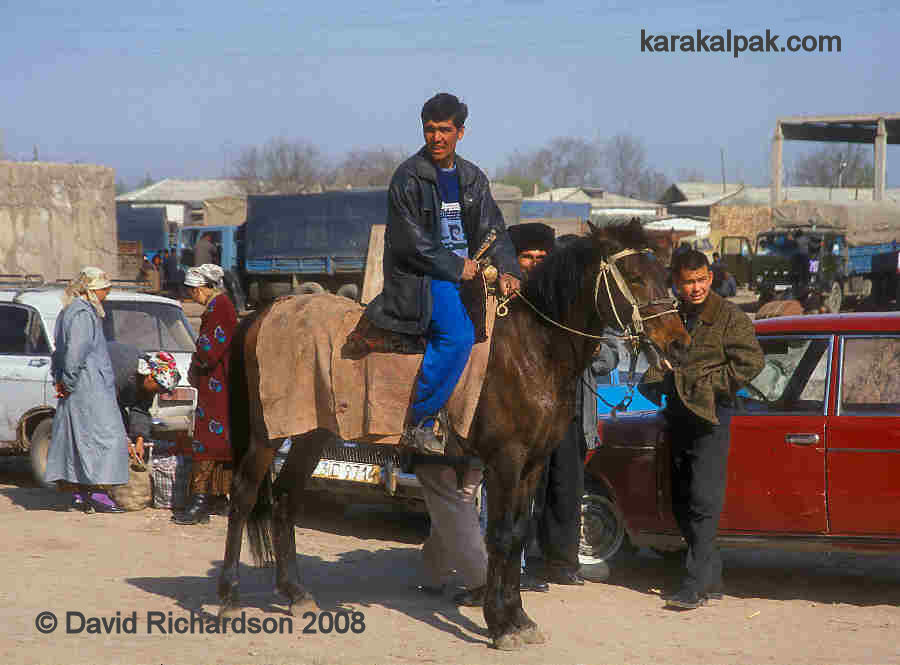
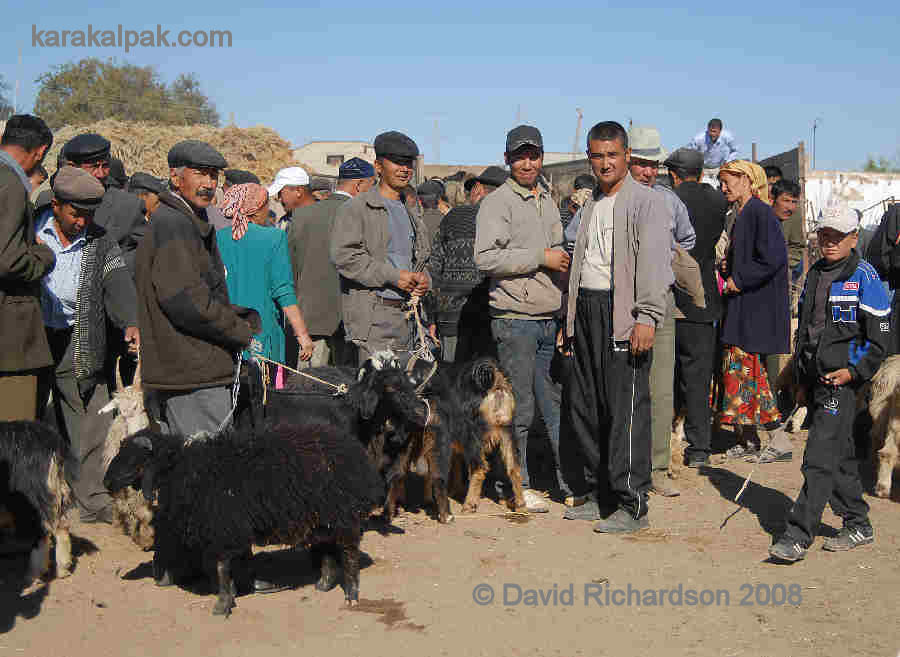
The Qon'ırat Karakalpaks were traditionally livestock farmers who raised cattle in the northern delta. On a Sunday you can see modern
livestock-breeders buying and selling their stock at some of the regional mal bazaars – mal refers to large livestock such as
cattle, horses, and camels, although sheep and goats are also bought and sold at these markets as well. The easiest bazaar to see from No'kis is
on the right of the main road from Xojeli to Qon'ırat, just north of Xojeli.
Xojeli Sunday Mal Bazaar.
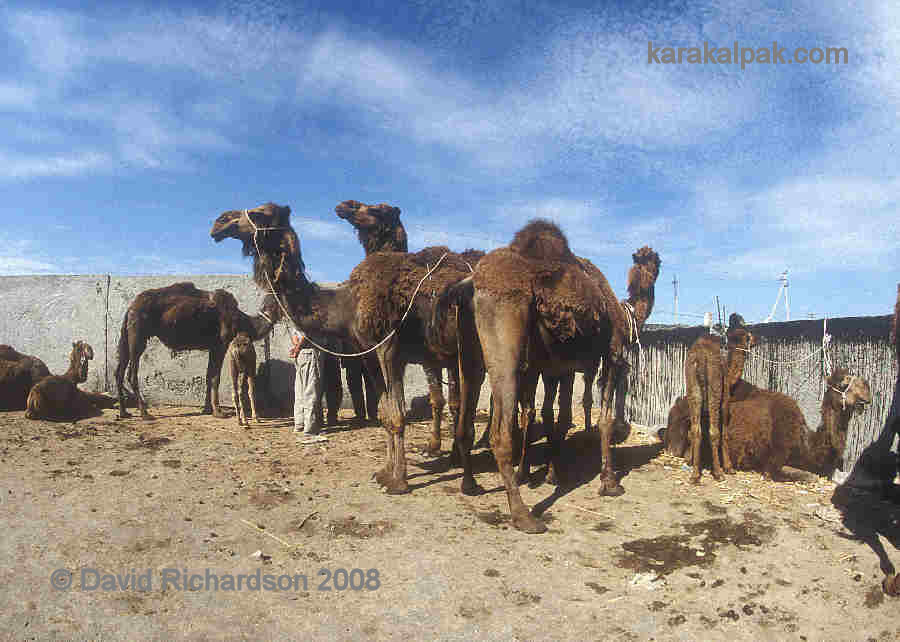
Camels for sale at Xojeli.
The opening price for a female camel and her baby was $700 in 2005.
Qon'ırat itself is also a major agricultural centre. Two days a week the main town bazaar turns into a much larger mal bazaar, with
people arriving from the outlying regions.
Taxta Ko'pir Sunday Mal Bazaar.
Trading goats at the Taxta Ko'pir Sunday Bazaar.
Farmers selling their vegetables at Taxta Ko'pir Sunday Bazaar.
However the biggest mal bazaar is at Taxta Ko'pir, located on the north-east side of the town. The bazaar takes place on a huge open space,
divided by a ditch. The mal bazaar takes place inside a walled enclosure at the very back of the market. Before you get there you pass
through people selling cabbages, ducks, geese, and bags of rice. On the other side of the ditch men sell car parts, TV sets, and building
materials. Inside another crowded walled enclosure you will find the retail vegetable and fruit market, along with traders selling modern carpets
made in Samarkand. Next to this is a big roofed section containing clothing and a garish display of textiles. To see the best of the market it is
advisable to make an early start from No'kis.
Shopping
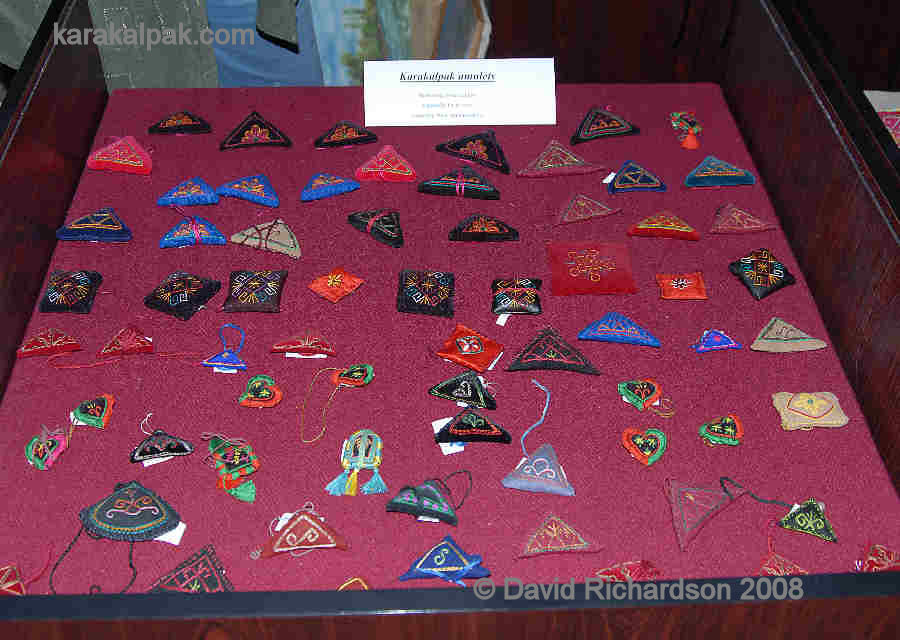
No'kis is not much of a place for shopaholics. The best souvenirs are examples of local handicrafts such as Karakalpak embroidery, appliqué,
and handwoven carpets. The best selection is available in the Savitsky Museum shop. The embroideries are made by local women, but the carpets are
made in several workshops organized by the museum, in No'kis and Shomanay. They use metal frame looms to make reproductions of some of the items
displayed in the museum.
|
Embroidered amulets for sale at the Savitsky shop.
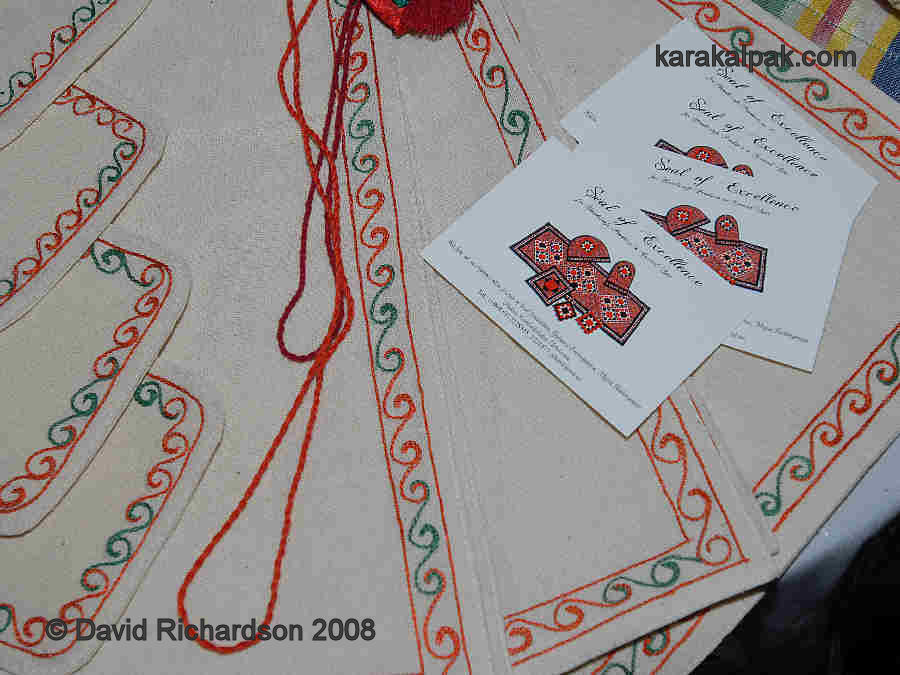
Some of the finest examples of local embroidery and appliqué work are produced by
the Golden Heritage of the Aral, a non-profit making cooperative of local women organized by Gu'lnara Embergenova and
Miyua Rasbergenova, 86 Ayımxan Shamuratova ko'shesi, No'kis, Karakalpakstan, 742000, Uzbekistan,
telephone (+998 61) 222 8565, 222 8577, e-mail: goldaral@nukus.silk.org
A beautiful set of embroidered table mats from Gu'lnara Embergenova.
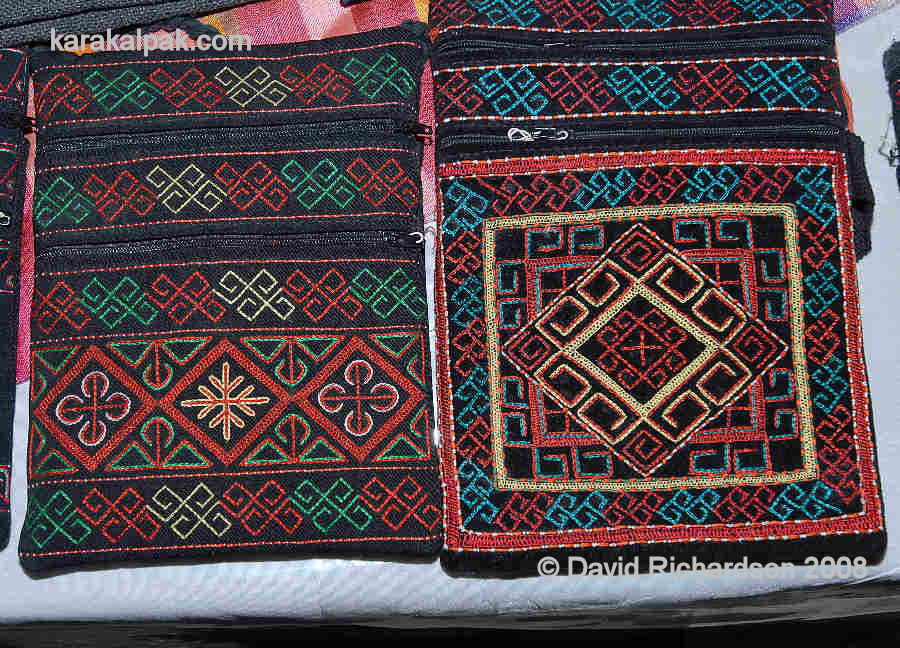
Gu'lnara has been awarded a Seal of Excellence by CACSA, the Central Asia Crafts Support Association. She specializes in women's handbags and purses.
Unfortunately Gu'lnara does not have a retail outlet of her own, and she sells most of her work in various outlets Tashkent, such as through the
Art Gallery shop located at Caravan Restaurant, 22, A. Kakhar
ulitsa, Tashkent. A few of her items sometimes appear in the Savitsky Museum shop.
Examples of embroidered Karakalpak purses.
The Jipek Joli Hotel also has a small selection of modern Karakalpak embroideries for sale.
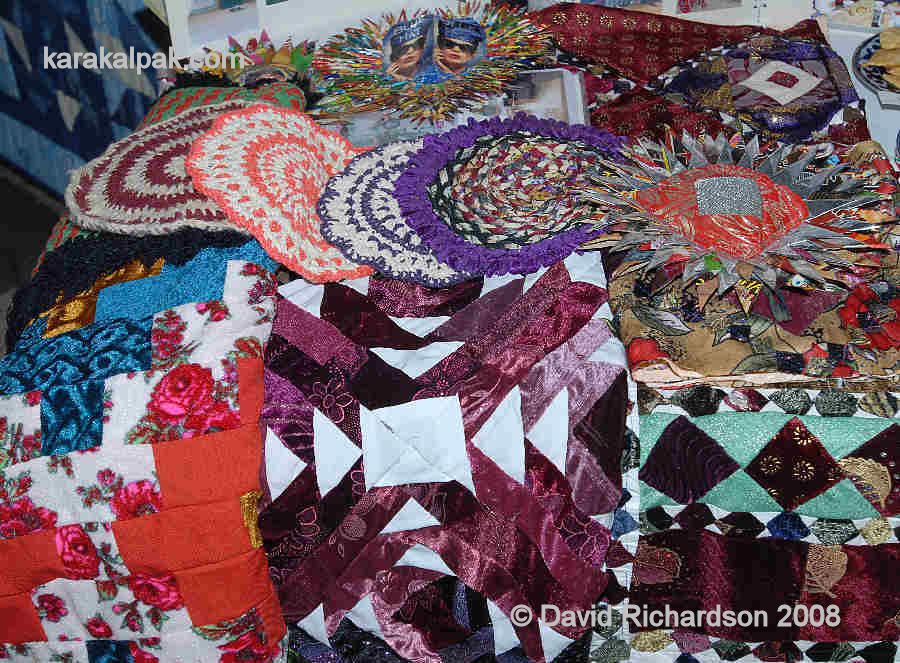
Another colourful local craft is appliqué. It is used to make decorative mats, cushions, and hangings. Examples can be found on several stalls
in the Central Bazaar.
Examples of Karakalpak appliqué and other textile crafts.
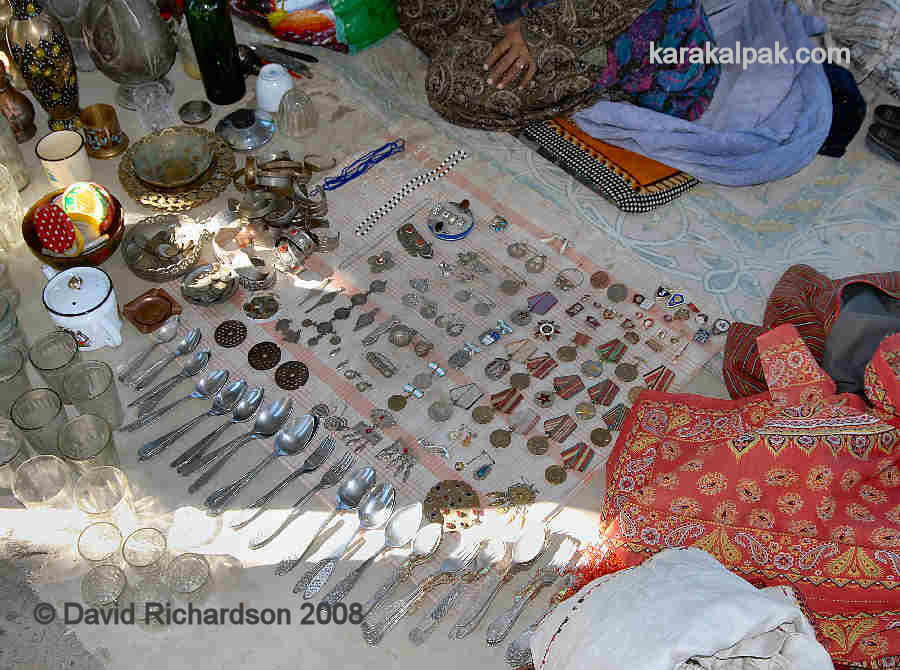
Old Russian kerchiefs make a nice gift for a wife or daughter and there is always a good selection on sale at the Central Bazaar. If you are lucky you
might find a small piece of local jewellery among the bric-a-brac being sold.
Spoons, medals, and oddments of jewellery for sale at the Central Bazaar.
The only bookshop in No'kis sells school textbooks. The only place to find books written in English is at the Savitsky Museum, in either the shop or
the ticket booth. Russian readers will find a good selection of titles in one section of the Central Bazaar or on the Sunday flea market by the
Qızketken Canal.
Visit our sister site www.qaraqalpaq.com, which uses the correct transliteration, Qaraqalpaq, rather than the
Russian transliteration, Karakalpak.
Return to top of page
Go to Part 2
Home Page
|
|