|
Contents
The Karakalpak Branch of the Academy of Sciences of the Republic of Uzbekistan, No'kis
The Karakalpakstan State Museum of Art named after Savitsky, No'kis
The Regional Studies Museum, No'kis
The State Museum of Oriental Art, Moscow
The Russian Ethnography Museum, Saint Petersburg
The Karakalpak Branch of the Academy of Sciences of the Republic of Uzbekistan, No'kis
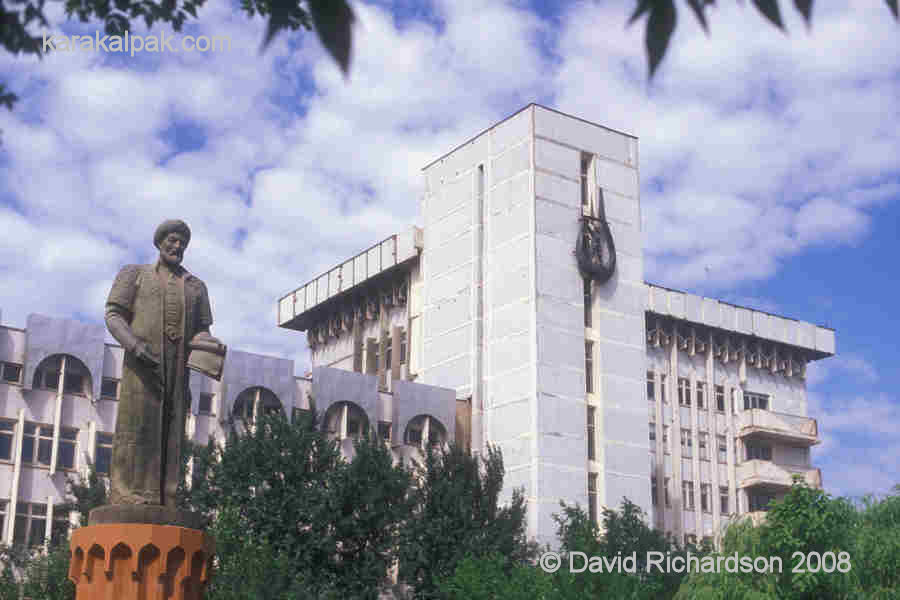
The Academy of Sciences from Berdaq Prospekt.
The Karakalpak Branch of the Academy of Sciences of the Republic of Uzbekistan was created in 1959 but its origins go back
to 1931 with the founding of the Karakalpak Scientific Research Institute. In 1939 this Institute was reorganized into the
Institute of History, Language and Literature, and later in 1947 into the Karakalpak Research Institute of Economics and
Culture. In 1957 it was renamed the Karakalpak Complex Research Institute.
Today it is comprised of five scientific research Institutes:
Complex Institute of Natural Sciences
Institute of Bio-ecology
Institute of Social and Economic Problems of the Aral Sea Area
Institute of History, Archaeology and Ethnography
Institute of Language and Literature named after N. Davkaraev
The members of these Institutes are involved with research across a broad spectrum, including the Aral Sea environmental
crisis, the petroleum geology of the Ustyurt region, the exploitation of local mineral deposits, and livestock and crop
breeding. Many have been on exchange programmes abroad and have participated in international conferences. Several
conduct research in collaboration with foreign Institutes; for example the Natural Sciences Institute works with
colleagues in the USA on tuberculosis and the Institute of History, Archaeology and Ethnography conduct joint excavations
with the University of Sydney.
There is also a botanical research garden which has the status of a scientific division.
A substantial library is housed within the Academy with many gems for the Karakalpak scholar including the
Sergey Tolstov library.
The Academy has published a scientific journal, the "Bulletin" since 1960. This covers a wide range of topics from all of the various Institutes. The index to this
bulletin can be found on the website of the Academy. This website also has a news section with up to date information
on forthcoming conferences.
Click here for the website of the Academy. Please note that the link is unreliable and sometimes does not open.
Return to top of page
The Karakalpakstan State Museum of Art, No'kis
The Karakalpak Art Museum (officially known as the Karakalpakstan State Museum of Art
named after Igor Savitsky) contains the world's finest collection of Karakalpak material
culture dating from the first quarter of the 20th century. The collection focuses
primarily on women's wedding and other ceremonial costumes and on yurt tent bands,
piled rugs, storage bags and other yurt decorations.
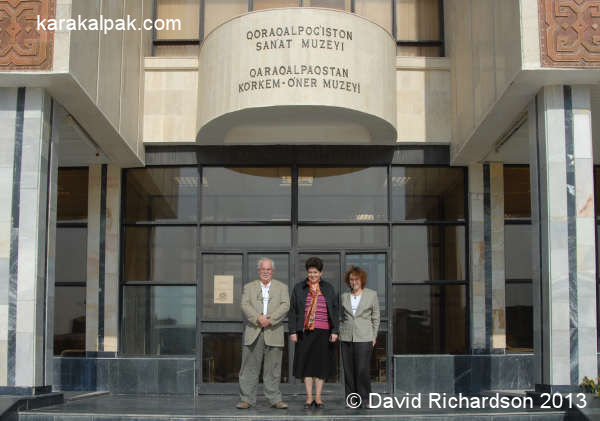
With the director, Marinika Babanazarova, at the museum entrance in 2007.
However, the museum's main claim to fame comes from its amazing collection of Soviet
avante garde paintings rather than from its ethnographical materials. Both were
collected by the museum's extraordinary and much-loved founder, Igor Savitsky.
Igor Vitalyevich Savitsky was born in Kiev in 1915, just before the October Revolution,
the son of a relatively well-off and established Ukrainian family – his father was a
lawyer and his grandfather a professor of Slavic studies. In the early 1920s his
family moved to Moscow and the young Savitsky was encouraged to draw and to paint,
going on to study at the "1905 School of Art". He was later sent to work in the
studio of a well-known local artist, who happened to be a friend of the Zhdanko
family (see below).
Savitsky worked at the Sounkov Institute from 1941 to 1946, avoiding conscription
on health grounds. In 1942 the Institute evacuated him to the relative safety of
Samarkand, giving him an opportunity to experience life in Central Asia at first
hand.
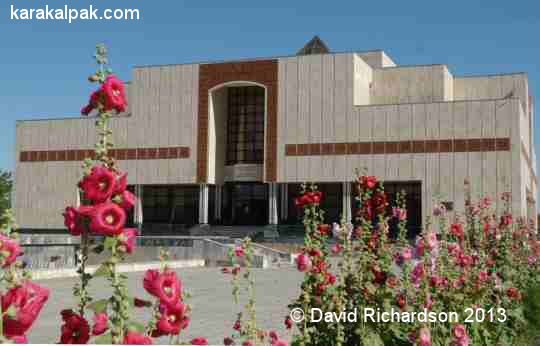
The new museum building in 2004.
Having returned to Moscow after the war, Savitsky was given the chance to return
to Central Asia in 1950. The ethnographer Tatyana Zhdanko invited him to join
the Khorezm Archaeological and Ethnographical Expedition, organized by the charismatic
Moscow archaeologist Sergey Tolstov. In Karakalpakstan Savitsky worked as an illustrator
for some seven years, attached to the Institute of Ethnography at the Academy of Sciences
in No'kis, sketching and drawing the monuments and finds excavated by the archaeologists.
It was during this period that he developed his interest in the ethnography of the
Karakalpaks being studied by Zhdanko and her team. He started to collect local
Karakalpak folk art, visiting towns and villages throughout the delta. As his
enthusiasm for local Karakalpak culture developed he decided to abandon his flat
in central Moscow and to go and live permanently in No'kis.
From 1957 to 1966, Savitsky worked at the Laboratory of Karakalpak Applied Art at
the Karakalpak Branch of the Uzbek Academy of Sciences. It was during this period
that he accumulated the core of his ethnographical collection, visiting villages
throughout the delta and purchasing examples of Karakalpak material culture from
bewildered shepherds, farmers and housewives. In time he had assembled thousands
of items representing every aspect of Karakalpak folk art: costume, jewellery,
carpets, yurt decorations, wood carvings, horse trappings and domestic utensils.
At the same time he continued to paint, encouraging young Karakalpak artists and forming
a local Karakalpak School of Art. He began to travel by train to Moscow, Leningrad, and
Tashkent, bringing back examples of Russian and Central Asian paintings from the 1920s
and the 1930s to inspire his fellow artists. As his collection of paintings grew, he
badgered the authorities in No'kis to establish a local art museum. His ambition was
achieved in 1966, when he was appointed director of the first Karakalpak Museum of Art.
The two decades following the Revolution had seen the emergence and flowering of a new
creative and original style of painting - the so-called Soviet school of art. But it
was short-lived. After Stalin's rise to power in the late 1920s, the cultural environment
became increasingly more conservative and authoritarian – especially during the dangerous
Stalin purges, from 1934 to 1941. Communist politicians encouraged artists to follow the
path of "Soviet realism" and those who failed to tow the line soon found themselves jailed,
exiled or confined to mental asylums. After the war Stalin initiated a further reign of
terror, encouraging a witch-hunt of "anti-Soviet" writers, artists, musicians, academics,
and scientists. Even jazz was banned. It was a sign of the times – in America a similar
witch-hunt was organized by the House Un-American Activities Committee.
Even though Khrushchev encouraged a more liberal environment following Stalin's death in
1953, painting remained a contentious subject. In 1962 Khrushchev had reacted to an
exhibition of abstract art in Moscow by exclaiming: "The people and government have taken
a lot of trouble with you, and you pay them back with this shit!" Twelve years later,
bulldozers were used to destroy an open-air exhibition of modern art in the same city.
Savitsky was undertaking potentially dangerous work, punishable by detention in a work camp
had he been exposed to the wrong people in Moscow. He was collecting the work of forgotten,
often forbidden artists, visiting their poverty-stricken widows or surviving family members,
who were more than happy to sell the sketches and canvasses languishing in their attics and
basements in return for some roubles or, if Savitsky lacked the funding, an IOU. His main
protection was that his museum was located in the remote, isolated and unheard-of territory
of Karakalpakstan. Even so he did not totally avoid scrutiny. As news of his collection
leaked out, he faced opposition from uncomprehending officials, attacks from jealous art critics
and visits from commissions of enquiry who warned him about continuing with his dangerous pursuit.
Fortunately Savitsky remained undaunted and his collection gained increasing notoriety. In 1969
some examples of the collection were displayed in the Museum of Oriental Art in Moscow and in
the 1970s the museum received its first foreign visitors. The Soviet Ministry of Culture even
began to help finance some of the museum's acquisitions. In 1981 the Union of Moscow Artists
held their meeting in the museum at No'kis. By now Savitsky had become a workaholic, sleeping
only a few hours a night and never taking a holiday. His health began to suffer and on several
occasions he was found in hospital in a dreadful state. He was eventually confined to a
hospital bed, from which he continued to run his museum, seeking yet more paintings for his
collection. After his release from hospital, he ignored medical advice to rest in a sanatorium
and continued his quest for new artists. His health continued to falter and he finally died
in hospital in Moscow in 1984. His body was returned to his beloved No'kis for burial.
We have met numerous people in No'kis who knew Savitsky well. Despite his one-dimensional passion
for his paintings, it seems that he was an extremely kind and humane man, taking great care of
his staff at the museum. A film about his extraordinary life was released in 2011. More information
on the "Desert of Forbidden Art" can be found here.
Ironically in the year following his death, Mikhail Gorbachëv came to power and ushered in the
period of glasnost (openness). At last it became safe for museums to open up their collections
of once forbidden art. Previously closed to foreigners, Karakalpakstan suddenly became accessible
to Western tourists following the Soviet collapse in 1991. The Savitsky collection provided the
new independent government in Tashkent with an opportunity to illustrate the oppression exerted
by their former Russian colonial masters.
In the past the State Museum of Art occupied two buildings in No'kis, the main art gallery on the
corner of Karakalpakstan ko'shesi, which was shared with the Regional Studies Museum, and the
ethnographical collection on G'a'rezsizlik ko'shesi. Both had a wonderful provincial atmosphere.
Following independence the Uzbek Ministry of Culture planned a new and larger building on a
green-field site close to Sharif Rashidov ko'shesi to house the entire Savitsky collection, and work on
the structure finally began in the late 1990s. However after completing the concrete shell, the
project ran out of money and it was not until 2002 that work recommenced to complete the building.
The new museum was officially opened by President Islam Karimov on 12 September 2003.
We thoroughly recommend a visit to this wonderful museum. The ethnography and archaeology collections
are displayed on the first floor and the art gallery is on the second floor. There is a very nice
café on the ground floor which is unfortunately closed at the moment, along with a cloakroom and toilets. The Director of the Museum is the
very approachable and helpful Marinika Babanazarova, who worked under Igor Savitsky and speaks
excellent English. The museum is very welcoming and has several English-speaking guides.
The museum can easily be visited by car from Khiva in one day (about 2 hours in each direction).
If staying overnight in No'kis, on no account should you stay at the abysmal Tashkent Hotel. The
Jipek Joly is the best hostelry in town. See our Tour Guide of Karakalpakstan.
The museum has a new multi-lingual website.
Click here for the website of the museum.
Click here to see a video of the museum.
Return to top of page
The Regional Studies Museum, No'kis
The Regional Studies Museum, sometimes called the Karakalpak State Museum for History and Regional Studies, is
the oldest museum in Karakalpakstan. It was founded as the Scientific Research Institute in 1929 at To'rtku'l, the former capital of the Karakalpak
Autonomous Oblast, which itself was only created four years earlier in 1925 as a province of Kazakhstan.
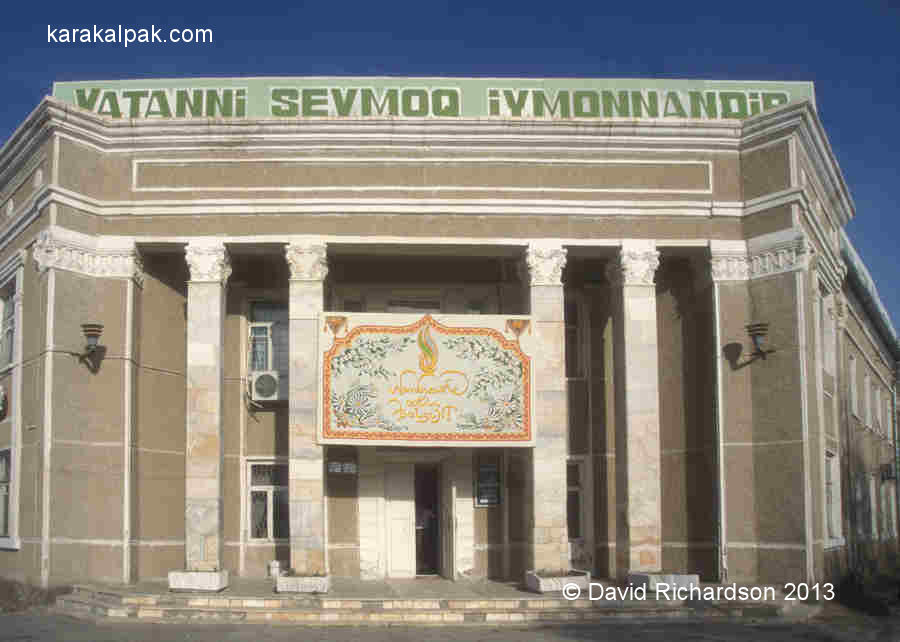
The former Regional Studies Museum in No'kis.
On 16 May 1929, the new museum opened in To'rtku'l with an exhibition of some of the costumes,
artefacts and photographs collected by Aleksandr Melkov during the previous seven months. By 1930 the museum
had over 1,000 exhibits.
In 1930 the Karakalpak Oblast was transferred from Kazakhstan to the Russian SFSR and was upgraded
to an Autonomous Soviet Socialist Republic in 1932. Finally in 1936 it was transferred from Russia
to the Uzbek SSR. The Karakalpak capital was relocated from To'rtku'l to No'kis in 1939 following the
destruction of the western part of To'rtku'l by the Amu Darya. The Regional Studies Museum finally moved
from To'rtku'l to larger premises in No'kis in 1942.
In 1965 the Regional Studies Museum moved a second time to a facility on the corner of Dosliq Guzari and
Karakalpakstan, although its official address was 2 Karakalpakstan Street. It neatly complemented the Savitsky Museum
with its ethnographic displays of male and female costume and animal trappings and coverage of the history and natural
history of the Aral region.
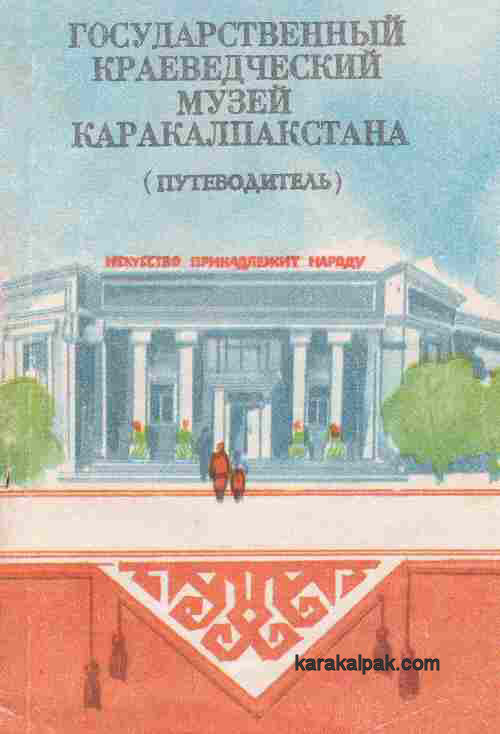
The cover of a 1992 No'kis publication about the museum.
Unfortunately it was closed at remarkably short notice in December 2010 and the building was demolished to make way for
a new development. Attempts to find a new location for the museum in the city centre have so far come to nothing. However
a small part of the former exhibition is currently on display in an upstairs room at a city-centre school building,
the Pushkin Gymnasium Number 1, 45 Turan Street. The opening times are from 0900 to 1700, Monday to Friday, and 1000 to 1600 on Saturday.
Admission is a modest 8,000 som, photography is free and tours in English are available.
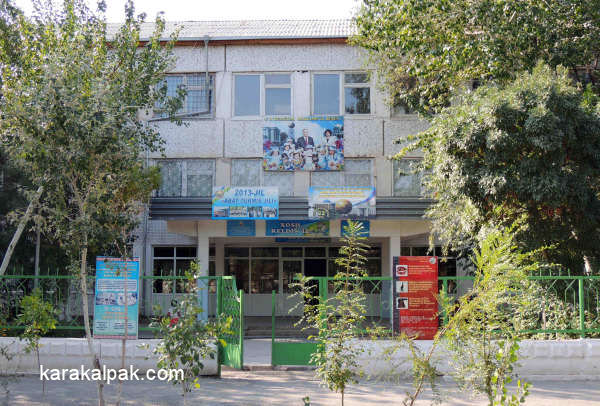
The Pushkin school building on Turan Street which houses the exhibition.
Because of limited space the exhibits on display are restricted but include a yurt, a number of paintings, some archaeological
artefacts and several natural history displays. Unfortunately the majority of the museum's 60,000-strong collection remains in
storage, including the sa'wkele, ko'k ko'ylek, and the fabulously embroidered jegde.
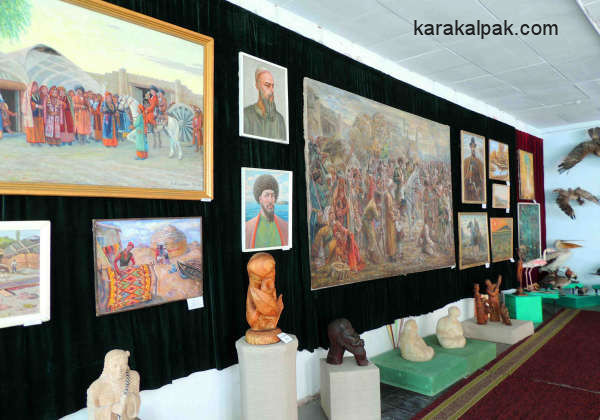
Part of the temporary display.
Return to top of page
The Karakalpak Rug Collection at the State Museum of Oriental Art, Moscow
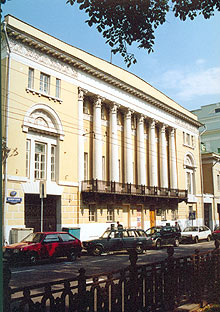
The Museum of Oriental Art, Moscow
The State Museum of Oriental Art was established in 1918 in the expropriated home of a wealthy Moscovite
on Nikitsky Boulevard. It has several items of Karakalpak embroidery on display among its collection of
Central Asian textiles. More importantly, its reserve collection contains 52 examples of carpet
items collected by Igor Savitsky between 1950 and 1957, and dispatched to Moscow in 1958. All the items come
from the Kegeyli region of Karakalpakstan, which is the main location of the Shu'yit clan. The collection
therefore contains a high proportion of Shu'yit nag'ıs qarshıns, as well as some excellent pieces probably
dating from the end of the 19th or beginning of the 20th century.
Dr Ludmilla Beresneva is the curator of the carpet collection. One of her first projects on joining the
museum was to write a short monograph on the museum's Karakalpak rug collection. In 1995 the now defunct
Oriental Rug Review (Volume 16, Number 1) published an article entitled "The Karakalpak Rug Collection at
the Museum of Oriental Art, Moscow", by L.G. Beresneva and A. S. Teselkin with a commentary by George
O'Bannon. This article is essentially an English translation of Beresneva's earlier Russian language monograph.
Click here for the article
Return to top of page
The Russian Museum of Ethnography, Saint Petersburg
The origin of the Russian Museum of Ethnography goes back to the founding of the Royal Russian Museum in 1895 by
the Emperor Aleksandr III. The museum had three departments, the Fine Art Department, the Memorials Department
and the Ethnographic Department. Under the leadership of Dmitry Aleksandrovich Klements, the latter was tasked with
representing the material cultures of the many different peoples living throughout the vast Russian Empire.
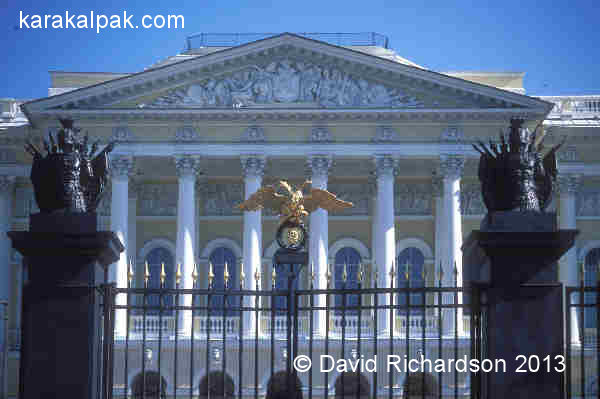
The Russian Museum.
Many works of art were donated to the museum by members of the Russian Imperial Royal family. The growing collection
soon placed demands on space and the architect V. F. Svinin was commissioned to design an imposing new building for
the Memorials and Ethnographic Departments. Construction began in 1902 and was completed in 1911, resulting in the classical
building that we see today.
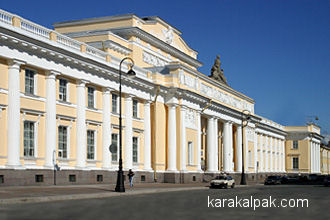
The Russian Ethnography Museum.
The first decade in the new building was one of considerable disruption as a result of the First World War and then the Revolution.
In 1934 the Ethnographic Department was finally granted independent status and became the State Museum of Ethnography
of the People of the USSR. After the Great Patriotic War it absorbed the entire collection of the Museum of Folk Culture
in Moscow.
In 1992, one year after Russian independence, it was renamed the Russian Ethnographic Museum.
The museum collection includes the famous Central Asian carpets acquired by Samuel Dudin from 1900 to 1903, along with his
historical photographs, and the small but rare collection of oriental carpets owned by General Bogolyubov. The REM has an interesting
collection of Karakalpak carpets and costume, all held in its reserve fund. Some of these items were donated by Aleksandr Melkov
and some were collected directly through the museum's own expedition to Karakalpakia.
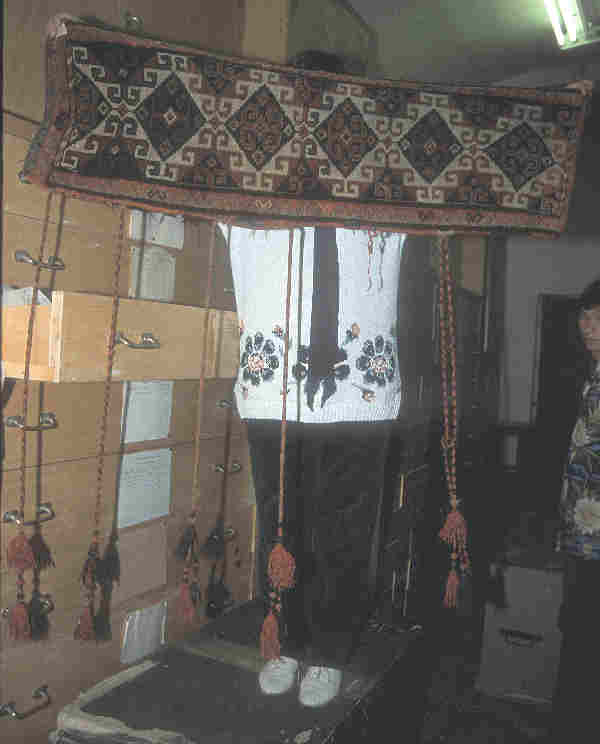
Dr Elena Tsareva displaying a complete esikqas from the museum fund, 2002.
At present there is only one webpage describing a few items from its interesting Karakalpak inventory. Unfortunately clicking on this site often brings
up a "threat detected" warning so you may prefer to view our translation of that page.
Click here for the museum's Karakalpak page in English.
For our own translation of this page click here.
Visit our sister site www.qaraqalpaq.com, which uses the correct transliteration, Qaraqalpaq, rather than the
Russian transliteration, Karakalpak.
Return to top of page
Home Page
|
|